
Your calendar is full, your chat apps are noisy, and the work still slips when no one is looking.
That is the strange part of remote work: the less visible the day, the more your habits matter.
The people who thrive usually do not have magical talent.
They build remote work skills that make ordinary days easier, cleaner, and far less fragile.
According to Business.com, communication and time management remain central to remote success.
That tracks with what many teams see every day: strong work is rarely about being online longer, and much more about being clear, steady, and self-directed.
The real edge comes from essential skills for remote work that compound over time.
A sharp written update, a calmer schedule, and better judgment in async settings can save hours each week.
That is why skill development for remote workers matters even when the job already feels manageable.
Small upgrades in focus, communication, and organization can turn a messy remote routine into one that actually holds up.
Quick Answer: Remote career growth comes from turning five behaviors into habits: async clarity, dependable prioritization, a lean collaboration workflow, proactive unblocking, and emotionally intelligent follow-through. Read this guide, then start with the skill that will reduce the most friction in your next two workdays—so you become easier to trust without needing to be online constantly.
Why These 5 Skills Matter for Remote Career Growth
Why do some remote workers keep getting bigger projects while others stay stuck proving they are “online”? The difference usually is not effort.
It is whether their remote work skills match how remote teams actually get things done.
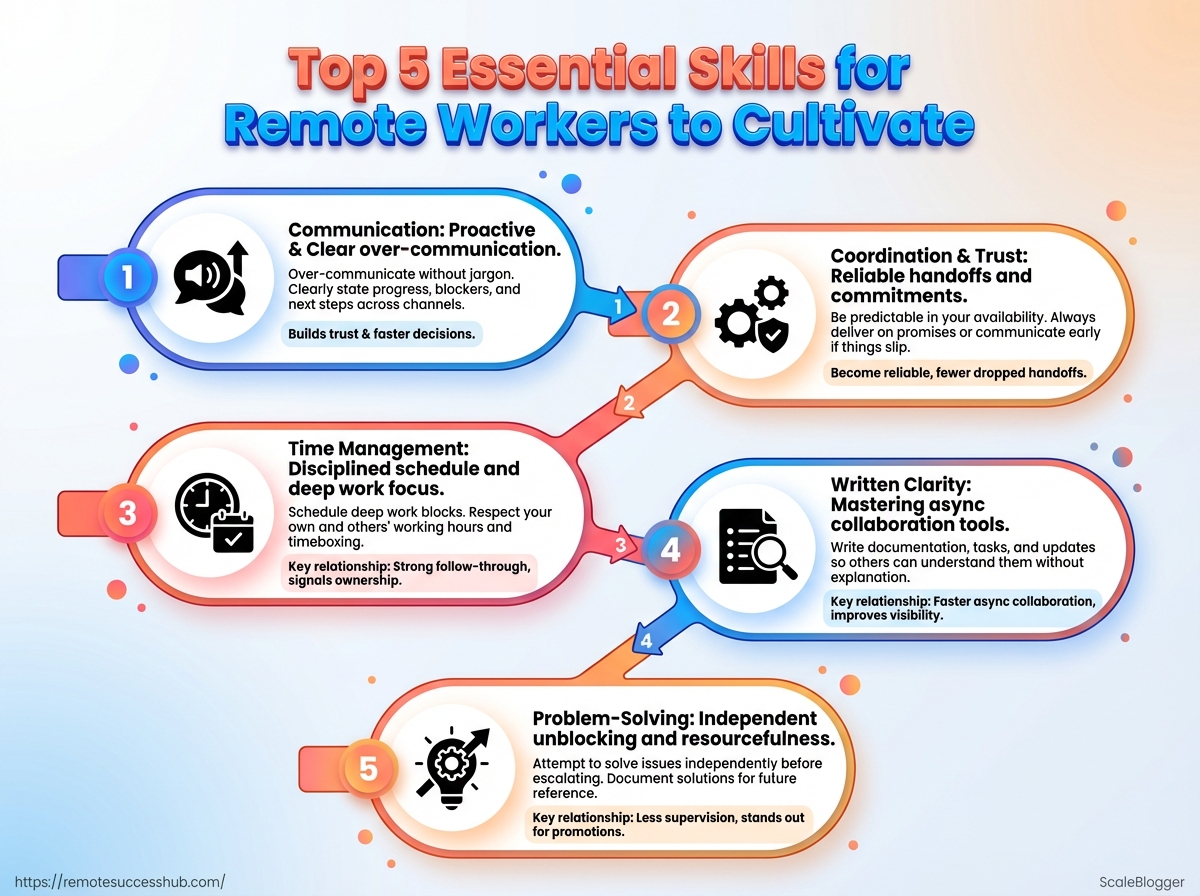
Communication, coordination, time management, written clarity, and problem-solving do more than smooth out the day.
They shape how much trust you earn, how visible you are, and how quickly people hand you more responsibility.
That lines up with Business.com’s remote worker skills guide and DailyRemote’s 2026 guide to the remote work skills employers want, both of which put communication and self-management near the top.
Consider two employees handling the same client change request.
One sends a crisp update, resets the timeline, and documents the next step.
The other answers late, asks for clarification in three messages, and leaves the team guessing.
How the performance gap shows up in daily work
| Skill | Primary Remote Work Benefit | Career Impact | Difficulty to Build |
|---|---|---|---|
| Communication | Clear updates and faster decisions | Builds trust with managers and teammates | Medium |
| Coordination and trust | Fewer dropped handoffs | Makes you the person people rely on | Medium |
| Time management | Strong follow-through in async work | Signals readiness for bigger ownership | Medium |
| Written clarity | Faster collaboration and fewer misunderstandings | Improves visibility in async teams | Medium |
| Problem-solving | Less dependence on constant supervision | Helps you stand out for promotions | High |
They reply clearly, keep projects moving, and make fewer avoidable mistakes.
That creates a steady performance gap, and it gets wider every quarter.
That pattern also shows up in Crossover’s 2026 remote thinking skills guide, which treats remote success as a mix of clear thinking and practical execution.
Skill development for remote workers is not about collecting badges.
It is about becoming easier to trust, easier to work with, and harder to overlook.
Those five skills do not just make remote work smoother.
They make progress visible.
1. Asynchronous Communication
A team can look busy and still be hard to work with.
The real test is whether people can move work forward without waiting for a live meeting.
That is why asynchronous communication sits near the top of modern remote work skills.
According to DailyRemote’s 2026 overview of remote work skills employers want, async communication is treated as the single most important remote-specific skill.
Business.com’s remote worker skills guide also puts communication right at the center of remote success.
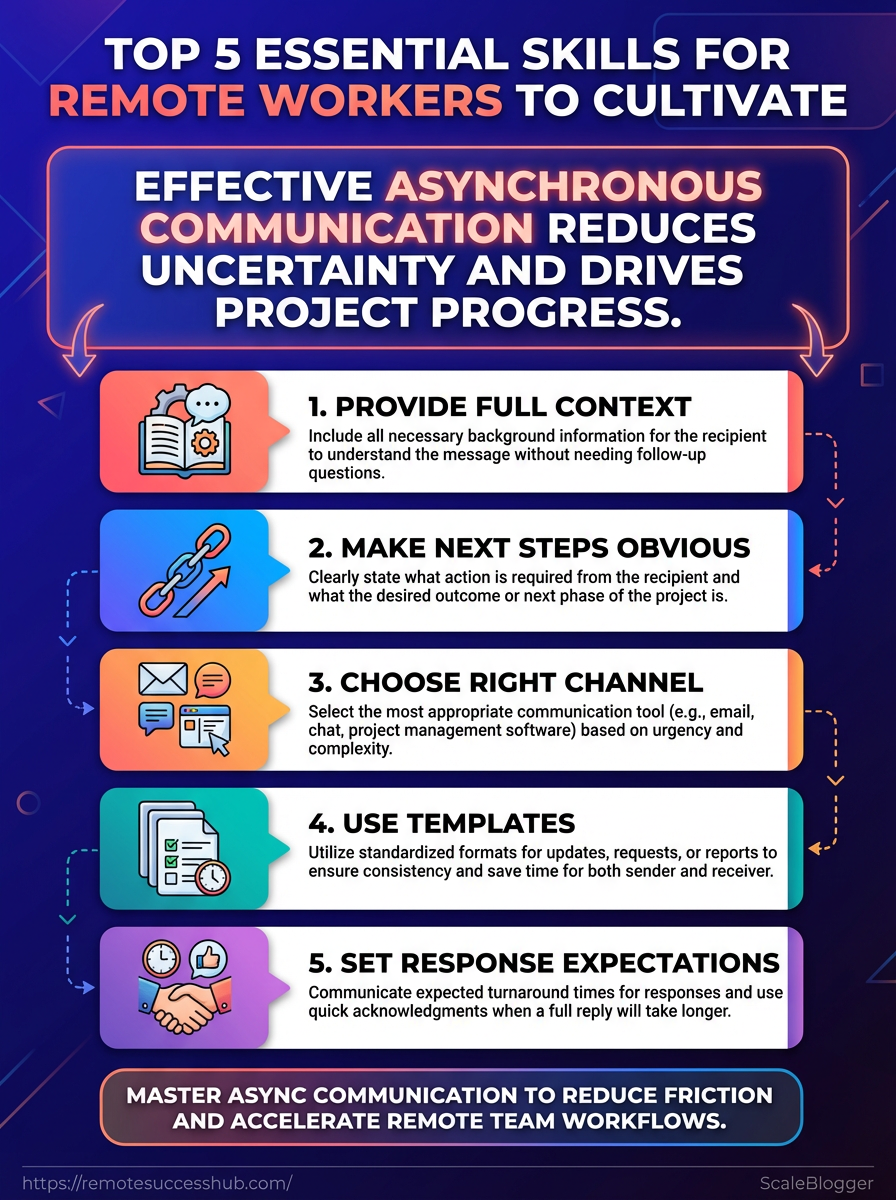
Strong async communication is not just “writing more.” It means giving enough context, making the next step obvious, and choosing the right channel for the job.
A vague message like “Can you check this?” creates drag; a better one says what needs review, why it matters, and when a reply is actually needed.
> Remote teams work better when messages reduce uncertainty instead of creating it.
Templates help because they remove guesswork.
A simple update format can hold the project name, current status, blocker, owner, and deadline, which saves everyone from decoding scattered notes.
Response habits matter just as much.
Set clear expectations for turnaround times, use quick acknowledgments when a full answer will take longer, and reserve live calls for decisions that truly need real-time discussion.
- Use a standard update format. Keep it short: context, status, blocker, next step.
- State the ask clearly. Say whether you need feedback, approval, or a decision.
- Acknowledge fast, answer fully later. A quick “seen, will reply by 3 p.m.” lowers anxiety.
- Write for the next reader. Assume someone will read the message three time zones away.
A practical habit is to draft messages once, then trim anything that does not help the recipient act.
That one edit usually cuts confusion fast and makes essential skills for remote work easier to prove in real projects.
When teams get good at this, meetings stop being the default for every question.
That leaves more time for deep work, and it makes every message do real work too.
2. Self-Management and Productivity
Remote work often fails in a quiet way.
Messages get answered, calendars stay packed, and the important work still slips.
Strong remote work skills depend on a system that decides what gets attention first, when it gets attention, and how much room it gets.
Recent guides from com/articles/remote-worker-skills/”>Business.com on remote worker skills and DailyRemote on skills employers want in 2026 both keep time management near the top for good reason.
The best setup starts with priority rules, not a bigger to-do list.
Crossover’s 2026 guide to essential thinking skills for remote jobs puts judgment and structured thinking ahead of busywork, and that matches what managers actually notice.
If a task does not move a deadline, reduce risk, or unblock someone else, it should not sit at the top.
Time blocking, task batching, and weekly planning keep the day from turning into random reactions.
Imagine a designer who protects 9:00 to 11:00 for deep work, batches feedback replies at 3:00, and spends Friday afternoon planning the next week.
That routine feels simple because it is.
It cuts context switching, makes deadlines easier to see, and gives skill development for remote workers a repeatable rhythm.
- Time blocking: Put focus work on the calendar first, before meetings and admin eat the day.
- Task batching: Group similar work, like replies, updates, or review, into one clean block.
- Weekly planning: Pick three outcomes every Monday and connect each one to real time on the calendar.
- Deadline control: Add a midweek check so drifting work gets caught before it becomes urgent.
- Focus reset: End each day by writing the next action, not just the next task.
Recent remote work trends from Splashtop’s remote work trends in 2026 still point to time management and collaboration as durable needs.
That is exactly why a steady weekly system beats heroic bursts of effort.
A tidy calendar will not make someone excellent overnight.
It does make progress visible, repeatable, and much easier to trust.
3. Digital Collaboration and Tool Fluency
Too many teams mistake more tools for better collaboration.
In reality, every extra app adds another place for decisions to disappear, files to drift, and people to ask, “Where did we put that?”
Digital collaboration is now one of the essential skills for remote work, not a nice extra.
Guides from DailyRemote on the remote work skills employers want in 2026 and Splashtop’s remote work trends for 2026 both point to digital communication, collaboration, and tech fluency as core parts of remote work skills.
That lines up with what teams feel day to day: when the stack is clear, work moves faster and fewer things get lost in translation.
A lean setup usually beats a fancy one.
The goal is not to know every platform on the market.
It is to know exactly where each kind of work lives, and to keep that rule simple enough that new people can follow it on day one.
Use one tool for one job
A clean stack usually has one place for chat, one place for shared docs, and one place for tasks.
Slack, Google Docs, and Asana are common examples, but the rule matters more than the brand name.
- Chat: quick questions, alerts, and handoffs.
- Docs: drafts, meeting notes, and decision records.
- Tasks: ownership, deadlines, and status.
- Video notes: short updates when live meetings would slow everyone down.
Build habits that cut friction
The strongest teams do a few things the same way every time.
They write decisions in one shared place, assign one owner per task, and leave a clean handoff note before logging off.
- Keep one source of truth for decisions and project status.
- Default to written handoffs when time zones do not overlap.
- Batch live meetings for work that truly needs real-time discussion.
- Tag by owner, not crowd, so responsibility stays obvious.
A London-to-Manila team, for example, can avoid a full day of waiting by logging every decision in one doc and every task in one board.
That is the kind of small discipline that makes skill development for remote workers feel practical instead of abstract.
These habits sound simple because they are.
They also save a lot of messy back-and-forth, which is where remote work usually starts bleeding time.
4. Proactive Problem Solving and Initiative
A remote teammate who waits for perfect instructions usually creates more work for everyone else.
The stronger pattern is simple: notice the snag early, name it clearly, and bring a workable path forward before the delay spreads.
That habit is one of the most valuable remote work skills because distance hides friction.
When no one can glance over your shoulder, small blockers can sit quietly until they become missed deadlines, broken handoffs, or confused stakeholders.
Research on essential skills for remote work keeps pointing in the same direction: remote professionals are judged not just on output, but on judgment, communication, and ownership. LinkedIn’s 2026 remote skills overview and DailyRemote’s list of remote skills employers want in 2026 both place initiative near the center of that picture.
Spot the blocker before it snowballs
The best remote workers do not wait until a project is visibly on fire.
They track early signals like repeated handoff questions, stalled approvals, unclear ownership, or a task that keeps bouncing between people.
A useful habit is to ask three quick questions whenever something feels off:
- What is blocking progress right now? Name the real obstacle, not the symptom.
- Who needs to know today? Share the issue with the person who can move it.
- What are two possible fixes? Bring options, not just alarms.
This approach works because it reduces decision lag.
Crossover’s 2026 thinking-skills guide frames remote success around judgment and problem solving, not just task completion.
Demonstrate ownership in writing
In remote teams, ownership becomes visible through documentation.
A clear note in the project doc, a short recap after a decision, and a follow-through message later all signal that the work will not drift.
A simple format helps:
- Decision made: what was agreed.
- Reasoning: why that path won.
- Next step: who owns the next move and by when.
That record keeps context from vanishing into chat history.
It also makes it easier for teammates to trust your judgment, which is a major part of skill development for remote workers.
A practical example: if a client request changes midweek, a strong response is not “I’ll handle it.” It is “The scope changed, here is the impact, here are two ways to proceed, and I will update the plan once you choose.”
That kind of ownership turns remote work skills into visible reliability.
And reliability is what gets remembered when bigger work comes up.
5. Emotional Intelligence and Relationship Building
Ever notice how one remote teammate can cool down a tense thread with two sentences, while another makes the same moment spiral for an hour? That difference usually comes down to emotional intelligence: reading tone, timing, and context well enough to respond like a person, not a notification.
In remote teams, that skill matters because trust has to be built through words, timing, and consistency.
Guides on remote worker skills from Business.com and remote skills employers want from DailyRemote both point to communication as a core capability, and that includes the quieter side of communication too.
The people who do this well tend to create fewer misunderstandings and stronger working relationships.
Read the room before replying. A short pause before answering a frustrated message can stop a bad assumption from becoming a bigger problem.
Name the feeling, not the flaw. “This sounds rushed” lands better than “This is messy,” especially when someone is already under pressure.
Ask one clarifying question. One good question often does more than three paragraphs of explanation.
Match the channel to the moment. Sensitive feedback usually belongs in a call or private note, not a crowded chat thread.
Close the loop clearly. A quick “I understand, and I’ll follow up by Thursday” builds reliability fast.
That kind of behavior is part of skill development for remote workers, because it helps people stay visible without overcommunicating.
The strongest remote work skills are not always loud.
They often look like calm judgment, clean follow-through, and feedback that keeps the relationship intact while the work moves forward.
At Remote Success Hub, we keep coming back to that balance because remote careers are built on trust as much as output.
When people feel understood, they stay engaged longer and work better together.
How to Develop These Skills in a Practical 30-Day Plan
Why does remote skill growth stall even when the workday is packed?
Usually, it is not a motivation problem.
It is a structure problem.
Recent 2026 guidance keeps pointing to the same remote work skills: communication, time management, collaboration fluency, and sharper thinking.
That pattern shows up across Business.com’s guide to remote worker skills, DailyRemote’s list of remote skills employers want, and Crossover’s 2026 thinking-skills roundup.
A simple month beats a heroic overhaul.
Ten to fifteen minutes a day is enough if the practice is specific and tied to real work.
- Days 1 to 3: pick one weak spot.
Maybe it was a vague message, a late task, or a messy handoff.
Choose the one that costs the most time, then build your month around it.
- Week 1: tighten written communication.
That habit matters because asynchronous communication remains one of the most important remote skills, and clarity saves everyone from guesswork.
- Week 2: protect your focus.
focus block for the task that usually slips.
End the day with a two-minute review: what moved, what stalled, and what needs first place tomorrow.
- Week 3: make your tools do more.
That is enough to build real fluency without turning the week into a software tutorial.
- Week 4: show initiative in the open.
Remote work gets easier when other people can reuse your answer instead of asking the same question again.
Imagine a project coordinator who spends one week cleaning up handoffs, another guarding deep-work time, and a third standardizing templates.
By day 30, the work feels smoother, and the change shows up in fewer follow-up pings.
We like plans that survive a busy week.
This one does, because it turns skill development for remote workers into small moves that actually stick.
The skills that keep remote work moving
The most useful thing to remember is that remote success is not about looking busy.
It is about being reliable when nobody is standing over your shoulder.
The five skills work as a system, too, because strong asynchronous communication still falls flat without self-management, and tool fluency feels empty without emotional intelligence.
The example that matters most is the simple one: clear updates, steady follow-through, and early flagging when something starts to slip.
Those are the essential skills for remote work that make trust build quietly over time.
For skill development for remote workers, repetition beats motivation almost every time.
Start today with one move: pick the skill that causes the most friction this week and use it in your next two workdays.
If messages are getting muddy, tighten your updates.
If deadlines keep wobbling, rebuild your daily plan.
Small corrections like that usually do more than a dramatic overhaul, and our remote work resources can help keep the practice grounded.