
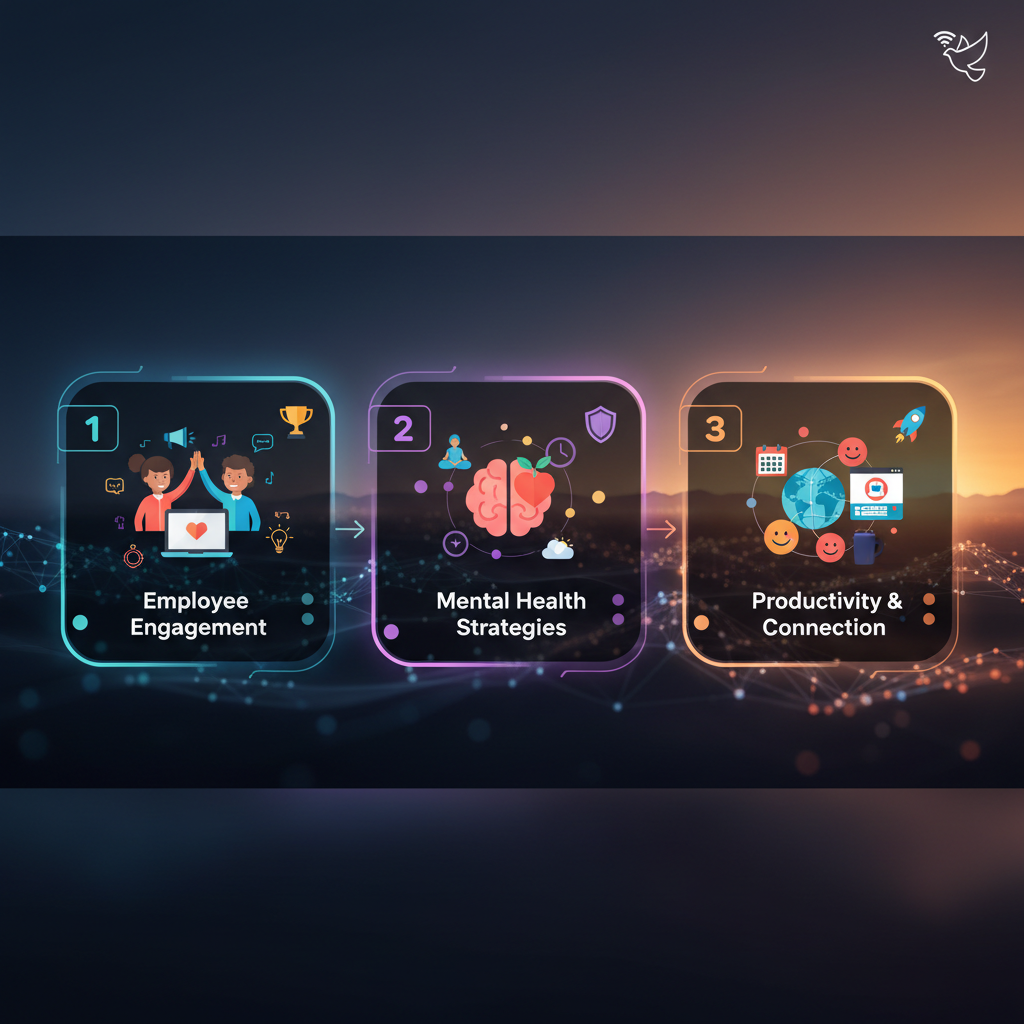
Your team hits deadlines, but Slack channels are quiet and people rarely speak up in meetings.
That quiet is not productivity—it’s a signal that trust and connection are fraying inside your remote work culture.
Small disconnections compound quickly.
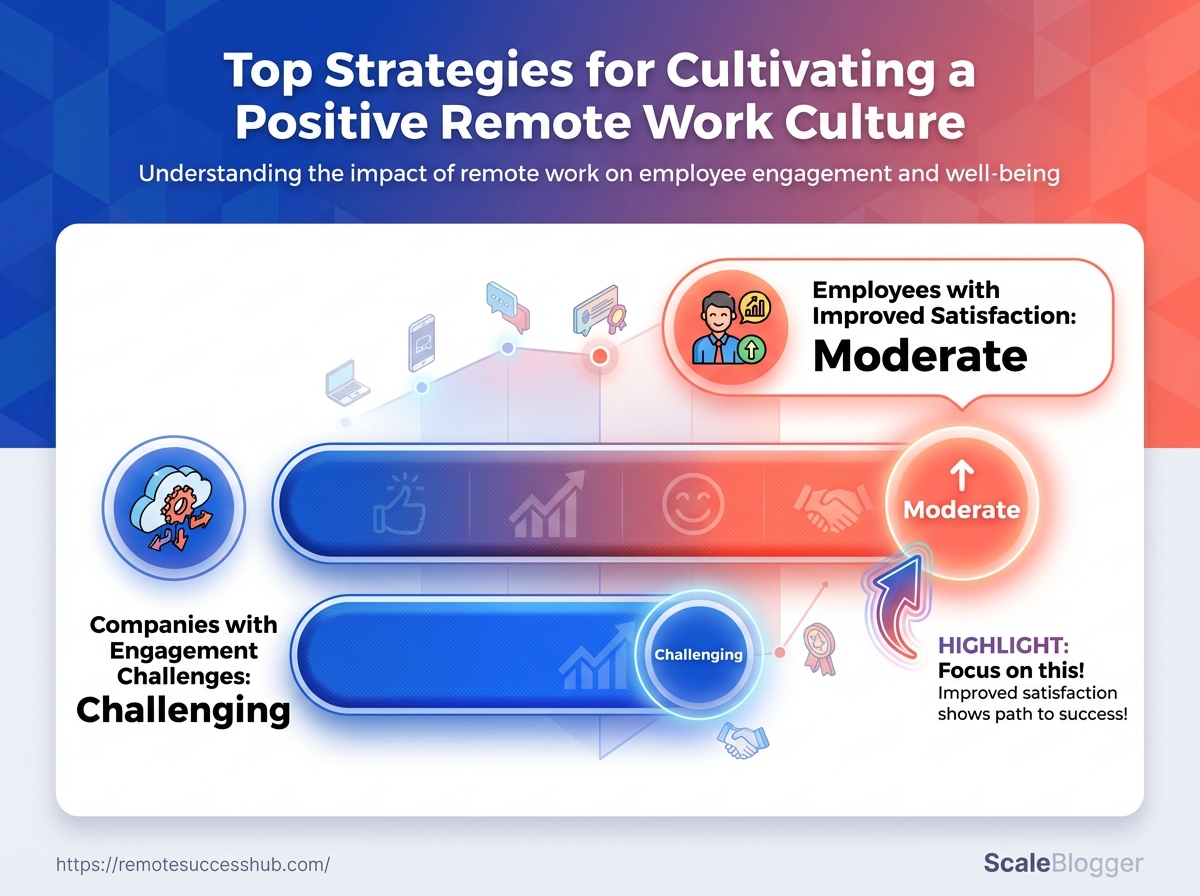
A 2026 Gallup survey found that 55% of companies reported challenges in employee engagement because of remote working conditions.
Well-being matters here.
As of 2025, 67% of employees said that well-being initiatives significantly improved their work satisfaction.
Tools like Slack keep conversations flowing, and platforms such as Lattice make feedback visible and habitual.
Pairing simple communication norms with concrete mental health strategies prevents small frictions from becoming systemic problems and lifts engagement across distributed teams.
Table of Contents
Hook and quick framing
What if remote work culture was the single biggest lever for your career growth? Imagine your network, visibility, and day-to-day learning all improving because your team norms actually amplified your strengths.
Remote culture isn’t just about Zoom etiquette or a Slack channel.
Culture shapes access to mentors, the frequency of meaningful feedback, and how visible your wins become.
Treating culture as a career tool changes the questions you ask at interviews and the habits you cultivate on the job.
That shift matters now more than ever.
Remote preferences are widespread — a Buffer survey found nearly all remote workers want to keep working remotely (survey year not provided in this brief).
At the same time, 55% of companies reported employee engagement challenges in a 2026 Gallup survey, and 67% of employees said well-being initiatives significantly improved job satisfaction as of 2025.
Career leverage: Build visibility and sponsorship through shared rituals, not luck.
Engagement wins: Small cultural fixes stop the slow erosion of motivation.
Well-being payoff: Psychological safety and flexible hours reduce burnout and improve performance.
Tool-driven practices: Systems like
daily stand-upsand async playbooks turn culture into repeatable behavior.
Why this matters now
Companies and employees are adjusting to hybrid norms while the data show rising tension between preference and practice.
When culture lags, opportunities shrink: fewer feedback moments, less advocacy, and slower promotions.
GitLab-style regular check-ins and tools like Slack reduce distance between contributors.
Lattice helps managers track engagement and structure feedback so remote contributions don’t disappear.
67% — Of employees reported that well-being initiatives significantly improve their work satisfaction (2025).
> 55% — Of companies reported challenges in employee engagement due to remote working conditions (2026).
How to use this article
Read it as a pragmatic playbook.
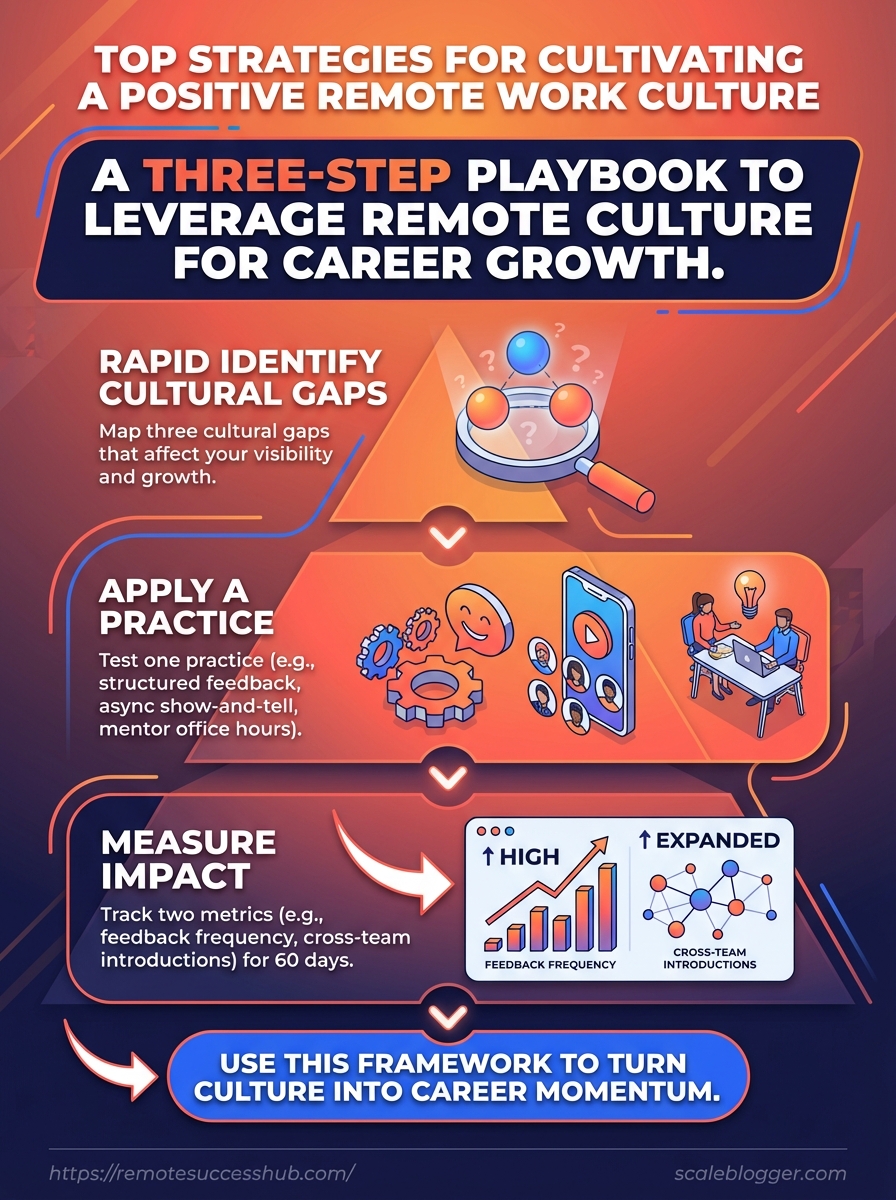
Use each section to diagnose, apply, and measure cultural changes that advance your career.
Identify: Map three cultural gaps that affect your visibility and growth.
Apply: Test one practice (examples: structured feedback, async show-and-tell, mentor office hours).
Measure: Track two metrics (feedback frequency, cross-team introductions) for 60 days.
Tools and examples live across platforms. For curated resources and templates, platforms like https://remotesuccesshub.com/ collect real-world playbooks and community tips.
This section sets the frame: treat culture as a deliberate, measurable lever.
The next sections show exactly how to turn it into career momentum.
Core principles of a positive remote work culture
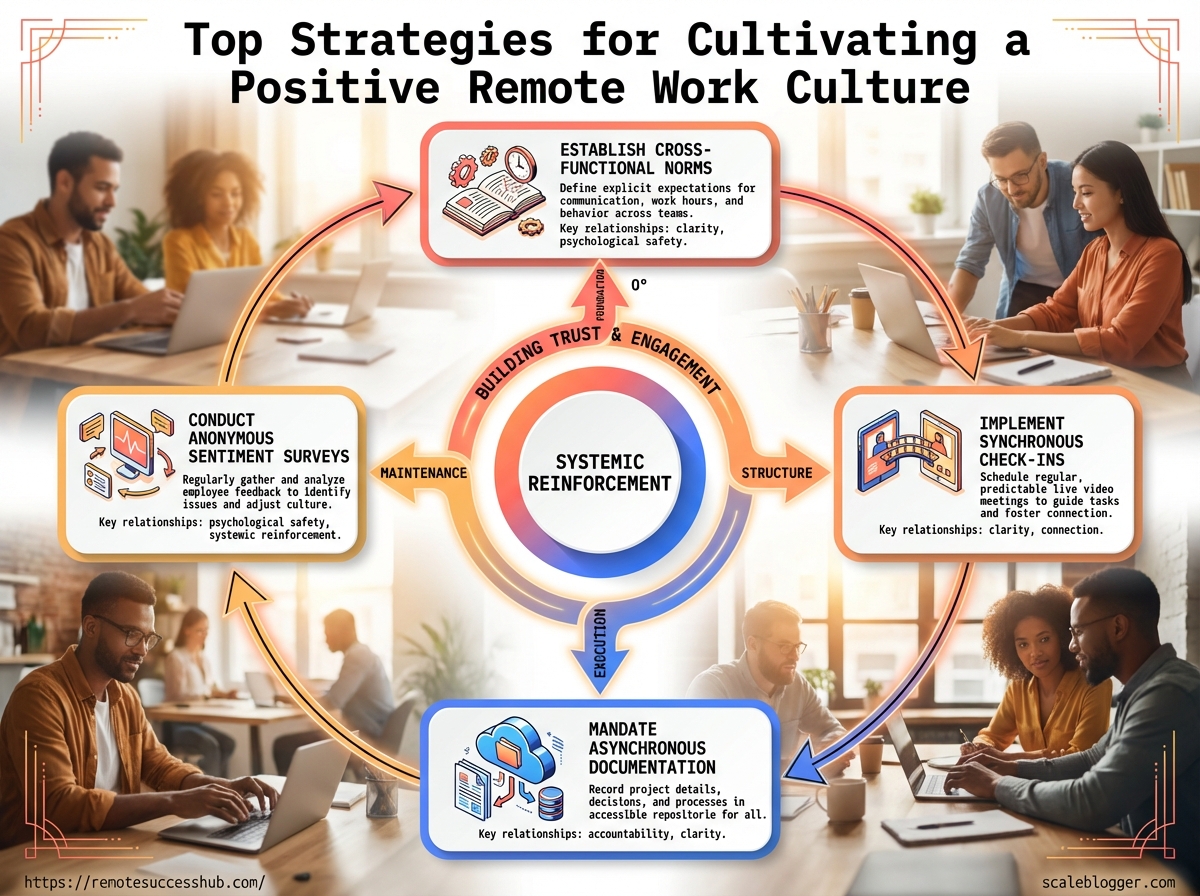
A healthy remote work culture rests on a few non-negotiable practices that actually move daily behavior, not just decorate the handbook.
Centering culture on psychological safety, clarity, and accountability shapes how people speak up, how priorities get decided, and how careers move forward inside distributed teams. Those three elements together create the conditions where engagement and performance scale reliably.
Remote work makes informal cues scarce.
That means culture must be explicit, measured, and reinforced through systems — from meeting norms to promotion criteria.
Practical steps that link culture to career outcomes keep the promise of remote work: visibility, growth, and sustainable productivity.
The three pillars — psychological safety, clarity, and accountability — are the backbone of every action below.
GitLab-style check-ins, tools like Slack and Miro for collaboration, and performance platforms such as Lattice are useful levers to operationalize them.
The three pillars: psychological safety, clarity, and accountability
Psychological safety: People feel safe to ask questions, admit mistakes, and offer new ideas without fear of reputational harm.
Evidence of safety: candid post-mortems, frequent constructive feedback, and high participation in async channels. Clarity: Roles, priorities, and decision rights are explicit and documented.
Clear decisions reduce rework and make promotion decisions objective rather than anecdotal. Accountability: Outcomes are tracked and owned, with transparent follow-up and growth-focused feedback.
Accountability ties day-to-day work to career signals like stretch assignments and promotion readiness.
Culture as a system, not a checklist
The diagram maps how the three pillars interact: psychological safety enables honest feedback, clarity focuses that feedback on the right goals, and accountability converts feedback into measurable outcomes.
Use it to spot where incentives or tools are misaligned.
Practical alignment tactics follow predictable patterns.
Make behavioral expectations part of performance reviews.
Reward collaboration and knowledge sharing, not just individual output.
Use async recognition (public kudos channels) to increase visibility for quiet contributors.
Align hires to behaviors: Hire for collaboration habits, not only skills.
Embed behaviors in reviews: Use Lattice or similar tools to score collaboration and learning.
Incentivize knowledge flow: Reward mentoring and documentation with stretch opportunities.
Measuring culture: practical KPIs that link to career progress
Employee engagement pulse — monthly scores tied to promotion readiness and internal mobility rates.
Psychological-safety index — percent reporting they can voice concerns; track trendlines before and after policy changes.
Participation in mentorship and peer reviews — higher participation correlates with faster promotions.
Internal mobility rate — percent of roles filled by internal candidates; a direct career-growth signal.
Well-being program uptake — use uptake as a proxy for support; 67% of employees reported (2025) that well-being initiatives significantly improve work satisfaction.
The 2026 Gallup finding that 55% of companies face engagement challenges underlines the need for ongoing measurement and action.
Use short, frequent pulses and tie results to concrete interventions: learning stipends, visible stretch projects, or revised promotion rubrics.
Culture isn’t a poster on the wall.
It’s a set of living, measurable systems that create real career opportunities for remote workers.
Practical strategies to boost employee engagement
Small, repeatable actions create more engagement than grand gestures.
A handful of reliable rituals and clear career signals keep people connected, productive, and motivated across time zones.
This section offers ready-to-use tactics: synchronous rituals that actually land, asynchronous patterns that protect deep work while widening participation, and a concrete 1:1 framework to link day-to-day work to real career progress.
Expect checklists, a simple step-by-step 1:1 flow, and a short video showing an asynchronous status template and handoff process.
Synchronous rituals that build connection
Routine but varied live interactions anchor remote teams. Short, predictable gatherings reduce uncertainty and create social glue without stealing a whole day.
Daily focused stand-ups: Two- or three-minute updates per person, capped at 15 minutes.
Use rotating facilitators to spread visibility.
Weekly micro-learning hour: One team member presents a 20-minute skill demo, followed by 10 minutes of Q&A.
Keeps skills current and surfaces hidden expertise.
Casual “coffee roulette”: Random 1:1 pairings every two weeks for 20 minutes.
Keep prompts ready to avoid awkward starts.
Town-hall spotlight: Monthly 10-minute spotlights where contributors share wins and blockers.
It raises visibility without long presentations.
These rituals work because they balance rhythm with low friction.
Companies like GitLab use short stand-ups to maintain alignment in distributed teams, and that pattern scales.
67% — Employees reported that well-being initiatives significantly improved their work satisfaction (2025).
55% — Companies reported employee engagement challenges due to remote work conditions (2026, Gallup).
Asynchronous practices that respect focus time and increase inclusion
Async design is about clear handoffs and predictable signals.
That makes collaboration inclusive and protects the deep work that drives outcomes.
Async statustemplate: Brief context → current blocker → what’s next → who needs to know.Post daily or on milestone completion.
Signal-driven calendars: Block
focus timewith a visible tag and require asynchronous updates for meetings inside that block.Document-first decisions: Save conclusions in a shared doc before meetings.
People can comment on their schedule.
Threaded async Q&A: Use dedicated channels for topics and assign owners to close threads with a final update.
The short video shows a 3-minute walkthrough of a lean async status template and a handoff process your team can copy.
Watch it to see exact phrasing and channel setup. Platforms like https://remotesuccesshub.com/ collect templates and community-tested examples for async workflows.
Career-focused 1:1s and growth plans
Make development the default agenda item in every 1:1.
Career signals are the strongest driver of long-term engagement.
Schedule a monthly 1:1 with a shared agenda document.
Start with a two-minute wins-and-blockers check.
Spend 10–15 minutes on skills and stretch goals.
Agree on one measurable action and a deadline.
Log progress in a shared growth plan (review quarterly).
Using tools like Lattice for growth-tracking and Slack for short updates ties conversation to measurable progress.
When managers make development visible, retention and motivation improve.
Small rituals, clear async patterns, and honest career conversations create momentum.
Use these tactics and the templates shown to make engagement a repeatable part of daily work.
Tools, platforms, and rituals — what to choose and why
What if the apps on your team’s dock could either speed work up or quietly slow everything to a crawl? Choosing the wrong set creates friction: duplicated work, lost context, and meeting creep. Choosing the right set reduces questions, surfaces progress, and keeps people connected without constant pings.
Pick tools that match how people actually get work done, not the shiny new feature set.
Limit the number of primary collaboration apps, prefer async-friendly defaults, and require good search and exportability so institutional knowledge isn’t trapped in message threads.
Rituals matter as much as software.
Small, repeatable habits—documented handoffs, async updates, recognition threads—make culture reproducible across time zones.
For templates and checklists, platforms like https://remotesuccesshub.com/ are useful reference points.
Selecting collaboration tools that reduce friction
Start by mapping the precise job each tool must do and what success looks like for that job.
Replace feature overlap with clear ownership: one tool for real-time chat, one for docs, one for project tracking.
Avoid tools that create work to maintain them.
Use these selection filters to avoid tool fatigue:
Purpose-fit: Choose tools that solve one primary problem well, not a dozen poorly.
Searchability: Ensure full-text search and export to keep knowledge accessible.
Async-first behavior: Prefer products with threaded conversations, comments, and action items.
Integrations, not silos: Pick software that integrates with your project tracker and calendar.
Low setup cost: Favor tools with gentle onboarding and good templates.
Comparison: common remote work tools and best-fit use cases
Tool comparison table
Tool | Primary strength | Best use-case | Cost tier (free/paid) | Accessibility & mobile support |
|---|---|---|---|---|
Slack | Real-time chat, channels | Team chat, quick decisions, async threads | Freemium — paid tiers for larger history & features | iOS/Android apps, keyboard navigation, screen reader support |
Microsoft Teams | Unified chat + meetings + Office integration | Enterprise collaboration with Office 365 | Free starter + paid via Microsoft 365 | iOS/Android apps, accessibility features, screen reader support |
Notion | Rich docs + databases | Knowledge base, lightweight wikis, SOPs | Freemium — paid for teams & advanced blocks | iOS/Android apps, limited screen reader support improving over time |
Confluence | Enterprise documentation | Structured team docs and policies | Paid (tiered) with trial | Web and mobile apps, enterprise accessibility features |
Zoom | Video meetings, webinars | Large meetings, webinars, screen-heavy calls | Freemium — paid for extended meeting lengths & features | iOS/Android apps, closed captions, keyboard support |
Google Meet | Video meetings integrated with Google Workspace | Quick video calls tied to calendar invites | Free + paid via Google Workspace | iOS/Android apps, live captions, accessibility features |
Miro | Visual collaboration whiteboard | Workshops, mapping, remote design sessions | Freemium — paid for team boards & integrations | iOS/Android apps, keyboard navigation, screen reader improvements |
FigJam | Design-focused whiteboard | Collaborative design ideation with Figma users | Freemium — paid with Figma teams | Web and mobile support, accessible workflows improving |
Asana | Project and task management | Cross-functional project planning and tracking | Freemium — advanced paid plans | iOS/Android apps, screen reader and keyboard support |
Jira | Issue tracking for engineering | Software teams managing backlogs and sprints | Freemium tier + paid growth plans | iOS/Android apps, accessibility features for workflows |
Trello | Visual kanban boards | Lightweight task boards and personal productivity | Freemium — paid for automation & power-ups | iOS/Android apps, accessible board navigation |
Teams usually do best when they explicitly assign which tool owns which activity rather than relying on shorthand assumptions.
The right mix typically includes one chat tool, one doc/wiki, one PM system, and one whiteboard for workshops.
That balance minimizes tool overlap while preserving flexibility.
Daily and weekly rituals that scale culture without adding meetings
Build rituals that make culture a repeatable system.
Rituals should be asynchronous when possible and require under five minutes of active time.
Consider these high-leverage rituals:
Daily async standup: Two-line updates: what I did yesterday, what I’ll do today, blockers — posted in a thread.
Weekly progress thread: Public highlights: one metric, one lesson, one ask — keeps visibility without a meeting.
Recognition channel: Peer shout-outs: quick kudos with tags and emojis to reinforce behaviors.
Document-first handoffs: Handover template: brief summary + links + decisions to keep work moving between time zones.
Focus-hours policy: No-meeting blocks: set predictable deep-work windows and enforce them calendar-wide.
67% — Of employees reported that well-being initiatives significantly improve their work satisfaction as of 2025.
Those rituals also support employee engagement and mental health strategies by giving people clarity and predictable touchpoints.
Integrating simple rituals into chosen tools keeps culture scalable and low-friction.
Choose fewer tools and stronger rituals; the combination is what actually moves the needle.
Designing onboarding and inclusion for remote teams
Think about the first week on a remote team.
New hires notice how meetings are scheduled, whether documentation is clear, and if someone actually remembers their name.
Those early signals decide whether they feel seen or invisible.
Design onboarding so signals stack positively: clear 30/60/90 milestones, rituals that respect time zones and language differences, and built-in peer networks that break isolation.
Employee well-being matters here — 67% of workers said well-being initiatives significantly improved work satisfaction (2025), and 55% of companies reported engagement challenges caused by remote conditions (2026, Gallup).
Those numbers make inclusion operational, not optional.
The rest of this section gives an actionable 30/60/90 plan, an inclusive practices checklist you can copy, and community tactics you can start this week.
Expect concrete owners, timing, and low-friction rituals you can test in the next sprint.
Onboarding checklist: first 30/60/90-day milestones
First 30 days — Foundations and relationships. Confirm equipment, system access, and role goals.
Schedule stakeholder intros, complete shadow sessions, assign a buddy, and share language-friendly docs.
Days 31–60 — Contribution and feedback. Assign a small, visible project with clear acceptance criteria.
Run a 30/60 feedback loop using a tool like Lattice for structured reflections and two informal check-ins with the manager.
Days 61–90 — Autonomy and career mapping. Move the hire to independent ownership of a feature or process.
Hold a 90-day career conversation and introduce them to cross-team forums where they can present learnings.
Inclusive practices checklist
Practical checklist for distributed teams (time zones, language, rituals)
Action | When to implement | Owner | Impact on inclusion |
|---|---|---|---|
Timezone-aware meeting scheduling | From day one; before recurring meetings | Team lead | Prevents systematic exclusion of off-hour team members |
Asynchronous agenda and notes | Immediately for all cross-team meetings | Meeting owner | Allows contributors in other zones to add input |
Rotating meeting times for global teams | Monthly rotation when needed | Program manager | Shares meeting burden across regions |
Local holiday acknowledgment | At hiring and annually | HR / People Ops | Signals respect for cultural calendars |
Language-friendly documentation (plain English) | Before onboarding materials published | Documentation owner | Reduces cognitive load for non-native speakers |
Captioned meeting recordings | Immediately for all recorded sessions | Meeting host | Improves accessibility and language comprehension |
Buddy/mentor assignment | Assigned on offer acceptance | Hiring manager | Provides a human contact and reduces first-week anxiety |
Flexible core hours policy | Set during offer and team charter | Team lead | Balances overlap with personal schedules |
Timezone-specific social hours | Begin in first 30 days and recur monthly | Community lead | Creates localized connection without late nights |
Accessibility accommodations process | Onboarding packet and 1:1s | People Ops | Ensures tools and workflows meet diverse needs |
Cultural onboarding sessions | Within first 60 days | Manager or culture lead | Builds shared norms and reduces misinterpretation |
Clear async response expectations | Included in team handbook | Team lead | Prevents assumptions about immediate availability |
This checklist combines HR best practices and practical meeting hygiene you can assign to owners immediately.
Start small: pick three items to implement in the next sprint.
Track uptake and iterate.
Peer networks and community-building tactics
Isolation shrinks fast without social scaffolding.
Peer networks convert task-focused relationships into career-sustaining connections.
Build them intentionally so they persist beyond the first 90 days.
Structured buddy program: Pair newcomers with peers for 8 weeks; meet weekly for role questions and cultural context.
Interest-based microgroups: Create async channels for hobbies or learning; rotate hosts monthly.
Cross-team coffee roulette: Automate random 1:1s to surface informal mentors and sponsors.
Office hours and drop-in clinics: Have product and people leads hold weekly slots for ad-hoc help.
Shared learning showcases: Invite new hires to present a 10-minute demo at month 2; it signals visibility and builds confidence.
These tactics reduce churn by making work feel social and career-oriented.
Use tools like Slack for async connection and scheduled rituals for predictable human time.
Remote inclusion is operational: design it into milestones, own it with named roles, and habit-stack small rituals that scale.
For more templates and checklists, platforms like https://remotesuccesshub.com/ collect ready-to-use playbooks tailored for remote teams.
Mental health and wellbeing strategies for sustained performance
What keeps a remote team firing on all cylinders isn’t longer hours or louder status updates.
Sustainable performance comes from small, repeated habits that protect cognitive energy and signal permission to rest. Remote work makes boundaries optional by default.
That increases the chance of exhaustion unless teams intentionally structure work, embed recovery rituals, and train managers to respond to mental-health signals without stepping on privacy.
Managers who treat mental health like a regular part of people management get better retention and steadier output.
Practical steps below map what to do, what to avoid, and which programs actually move the needle.
Prevent burnout: structure, boundaries, and recovery rituals
Create predictable structure so people can plan around deep work and life.
Use fixed meeting blocks, no-meeting windows, and a visible daily shutdown ritual to reduce decision fatigue.
Recovery rituals matter as much as schedules.
Encourage short, frequent microbreaks, ritualized end-of-day shutdowns, and regular “no-work” days after intense sprints.
Fixed meeting blocks: Reserve two consistent hours daily for collaboration and keep the rest for focused work.
Daily shutdown ritual: One clear step (e.g., update task status, send a wrap note) that signals the end of the workday.
Microbreaks: 5–10 minute breaks every 90 minutes for movement or fresh air.
Why it works: structure reduces cognitive load and makes taking breaks socially acceptable.
Manager practices to support mental health without overstepping
Treat disclosures as starting points, not action items. Listen, ask permission to act, adapt workload cautiously, and offer resources instead of diagnoses.
The flowchart shows a simple decision path: listen → assess immediate risks → ask permission to adjust workload → offer resources (e.g., EAP) → follow up. It separates private support actions from formal HR steps.
Open listening: Begin with “Can you tell me what would help?” then mirror back concerns.
Ask for consent: Offer help only after permission; document next steps privately.
Triage and refer: For clinical or safety concerns, connect to
EAPor HR quickly.Follow-up cadence: Short check-ins weekly until normal workflow resumes.
Why it works: this approach balances care with respect for personal boundaries and legal considerations.
Resources and programs to offer: EAPs, coaching, microbreaks
Employees respond when support is concrete and easy to use.
As of 2025, 67% of employees said wellbeing initiatives significantly improved work satisfaction.
Yet in 2026, 55% of companies still reported engagement challenges tied to remote work conditions.
EAP access: Ensure confidential, easy-to-access
EAPenrollment and clear instructions.Coaching stipends: Offer short-term coaching for stress management and role transitions.
Microbreak prompts: Provide calendar tools or lightweight apps that remind teams to pause.
Manager training: Train managers on referral steps, privacy, and respectful check-ins.
Peer-support channels: Enable moderated Slack or dedicated spaces for sharing coping strategies.
Tools like Lattice can help track engagement signals, while Slack and Zoom facilitate both social connection and access to wellbeing resources.
Platforms like https://remotesuccesshub.com/ can also be useful for curated remote-work wellbeing toolkits.
Sustainable performance depends less on heroic effort and more on regular mental hygiene.
Small system changes make rest visible and acceptable, which keeps people productive longer.
Measuring impact and iterating culture programs
What if you could tell within a month whether a culture change actually moved the needle? Tracking culture is less mystical than it looks when you combine clear quantitative signals with short, frequent qualitative checks.
Remote teams can lean on both hard metrics — retention, engagement scores, decision velocity — and soft signals from pulse conversations and forum threads.
The aim is simple: detect change quickly, learn fast, then scale what works.
Practical measurement avoids long, once-a-year surveys that arrive too late.
Use short pulses, manager feedback, and product/operational signals tied to day‑to‑day work.
Companies like Lattice and Slack built tools and patterns around that approach, while GitLab’s regular check‑ins model shows how cadence keeps alignment tight.
Recent data also matters: 55% of companies reported employee engagement challenges in remote settings in a 2026 Gallup survey, and 67% said well‑being initiatives boosted work satisfaction as of 2025 — those trends should shape what you measure and how often.
Qualitative feedback loops: pulse interviews and culture forums
Metric | Collection method | Frequency | Action threshold / next step |
|---|---|---|---|
Engagement score | Anonymous pulse survey via | Biweekly | Score drop >6 points → run 1:1 pulse interviews within 7 days |
Voluntary turnover rate | HRIS exit tracking (monthly cohort) | Monthly | 2% month-over-month increase → launch retention interviews and manager review |
Average time-to-decision | Project management analytics (Asana/Jira cycle time) | Weekly | Increase >25% over baseline → diagnose meeting load and decision owner clarity |
Manager 1:1 satisfaction | Short post-1:1 feedback form (Slack/Forms) | After each 1:1 | ≤70% positive → coach managers and map 3 improvement actions |
| Simple 3-question pulse survey | Quarterly | Score ≤0 → cross-functional listening forum + action plan |
Psychological safety index | Facilitated focus groups + anonymous forum posts | Monthly | Significant negative themes → targeted manager workshops |
Active forum participation | % of team posting/ reacting in culture channels | Weekly | Participation <30% → run content experiment and moderated AMA |
Burnout / well‑being index | Self-reported wellbeing survey (3 items) | Biweekly | >15% high-risk flags → activate mental health resources and adjust workload |
Learning uptake | Completion rate for L&D micro-courses | Monthly | Completion <40% → redesign course format or incentives |
Meeting effectiveness score | 1-question post-meeting poll | Per meeting | <3/5 average → update meeting charter and attendee list |
Measuring both numbers and narratives prevents overreacting to noise.
The table above ties each metric to an operational step so leaders can act instead of guessing.
What to do with the signals
Start tiny: Pilot one metric and one qualitative loop for a single team for 6 weeks.
Track change weekly and record hypotheses.
Treat failures as data: If a pilot misses targets, log what changed and run a lightweight root-cause check with managers.
Scale what moves outcomes: When a pilot shows improvement in at least two metrics (e.g., engagement and time‑to‑decision), expand to adjacent teams for another 6–8 weeks.
Automate reporting: Feed key metrics into a dashboard and flag thresholds for human follow-up.
Close the loop: Publicize what actions came from feedback — that habit increases participation and trust.
Iterate quickly, measure what matters, and make every culture change accountable to outcomes.
Trust the data, but keep the conversations human.
📥 Download: Download Template (PDF)
Conclusion
Turn quiet signals into steady connection
What if quiet Slack channels were treated like a symptom instead of a sign of success? The most valuable insight here is that remote work culture only thrives when trust is built deliberately and measured regularly.
Rituals, onboarding design, and compassion-driven practices are not extras; they are the mechanism that turns transactions into relationships.
Think back to the onboarding buddy and weekly pulse example: those small, repeatable touches surface real feelings faster than annual surveys ever will.
Pairing those rituals with clear metrics keeps employee engagement visible and informs mental health strategies that actually stick.
When teams track both participation and wellbeing signals, iteration becomes practical instead of wishful.
Start with one small experiment this week: schedule a 30-minute listening session with your team and ask three open questions about connection and workload. Tools like Remote Success Hub can help you find templates and set up a simple pulse.
Can you run that session before the week ends and treat whatever you hear as the first data point for change?
What are the benefits of remote work culture?
A strong remote work culture improves connection and keeps employees engaged even when they are dispersed. When well-being is prioritized, it directly increases satisfaction—67% of employees reported that well-being initiatives significantly improved their work satisfaction (as of 2025). It also helps prevent small disconnections from compounding into quieter communication and lower trust.
How do companies measure employee engagement in remote work?
Companies measure engagement by tracking signals like participation, communication, and feedback adoption across remote channels. Common indicators include whether employees speak up in meetings and how frequently teams interact in tools like Slack. Many organizations also rely on employee engagement survey results; a 2026 Gallup survey found 55% of companies reported engagement challenges tied to remote working conditions.
What are effective strategies for team building remotely?
Effective remote team building focuses on rebuilding trust and creating regular, visible opportunities for participation. Use collaboration tools like Slack to keep conversations active and reduce quietness that signals disconnection. Make feedback ongoing and habitual with platforms such as Lattice, so employees receive consistent input rather than waiting for infrequent check-ins.