

Most remote hires remember their first week for what they didn’t get: context, connection, and clear next steps.
Effective remote employee onboarding fills those gaps fast, turning awkward silence into useful momentum.
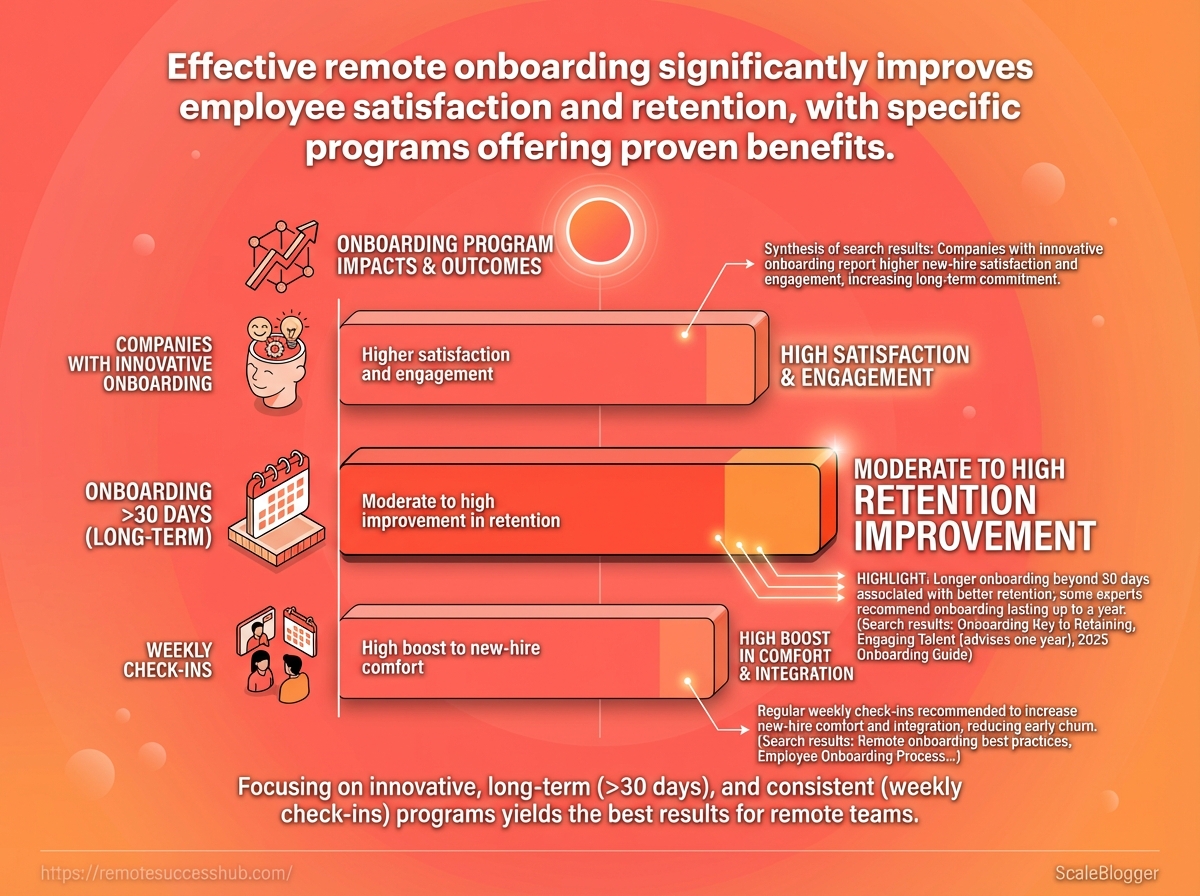
A 2025 SHRM survey found 82% of companies using innovative onboarding practices reported higher employee satisfaction.
A 2025 Talent Management Institute report showed retention improves 52% when onboarding lasts longer than 30 days.
Practical engaging onboarding programs borrow tactics that work: Zapier’s self-paced courses and checklists, Asana’s buddy system, and Slack’s gamified quizzes.
A 2025 LinkedIn Learning study found weekly check-ins during the first month significantly boost new-hire comfort.
VR and live leadership Q&As make remote work training feel human.
When onboarding falters, new hires stall on productivity and drift away from team norms.
That quiet disengagement costs teams time and morale.
Good programs set small, measurable milestones, not endless orientation slides.
They combine clear role goals, social rituals, and hands-on tasks that build momentum.
Build onboarding that signals welcome, sets expectations, and accelerates contribution from day one.
Table of Contents
Why remote onboarding must evolve beyond paperwork
Most remote programs still treat onboarding as admin: forms, IT setup, policy reading.
That approach checks boxes but does little to help someone join a team, learn culture, or start contributing quickly.
New hires remember experiences, not completed fields.
Early weeks shape belonging, confidence, and how fast someone reaches meaningful productivity.
Paperwork is necessary.
It is not sufficient.
The gap today: common failures in remote onboarding
Remote teams routinely skip social design.
New hires get a laptop and a PDF manual, but no real introductions or guided practice.
That creates isolation and confusion.
Technology without context also fails.
A login is useless if the employee doesn’t know which channels to use for decisions, feedback, or escalation.
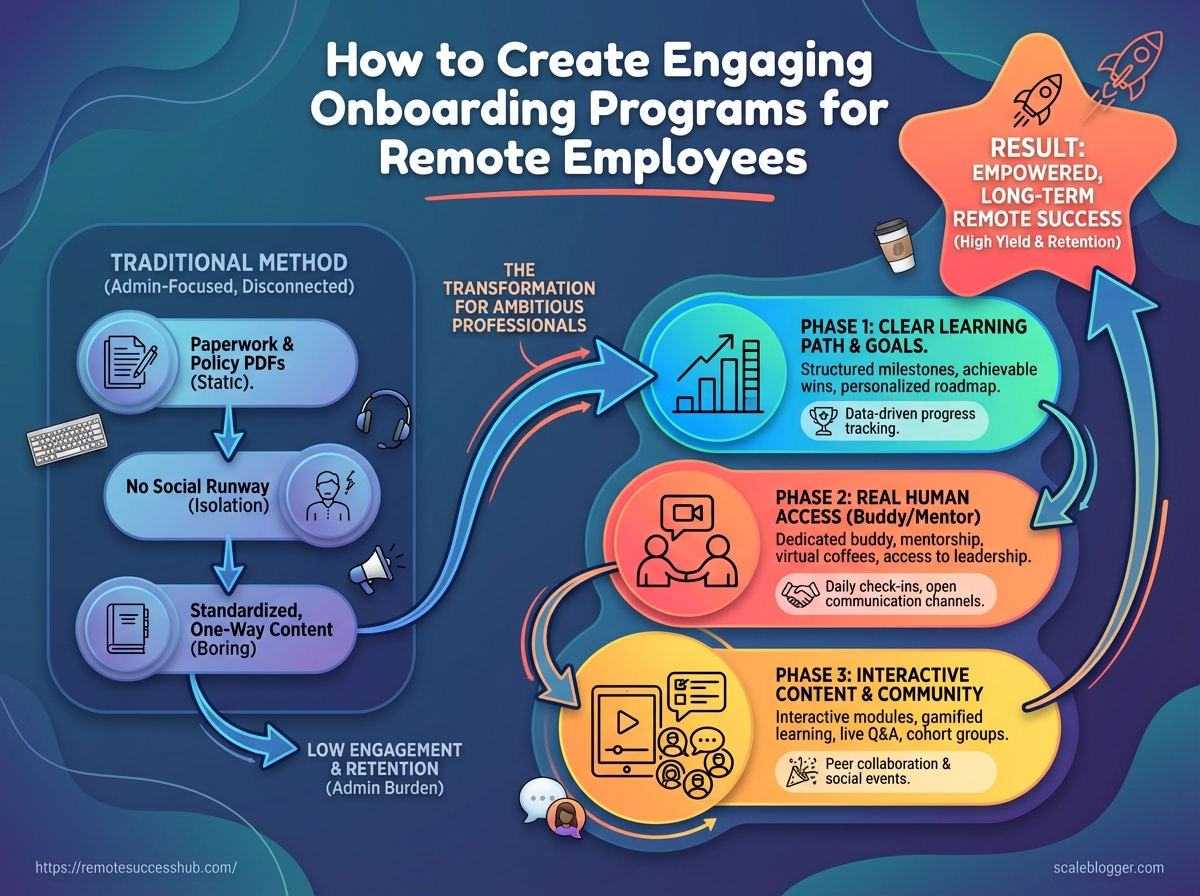
No social runway: New hires lack structured calls or buddy time during the first two weeks.
One-way content: Companies push policy PDFs instead of interactive learning or role-based simulations.
Missing feedback loops: Onboarding ends without collecting early feedback, so problems repeat.
Siloed training: Tools and process training happen separately from actual team workflows.
The business and career case: retention, ramp speed, and long-term growth
Faster ramping reduces costs and improves morale.
When onboarding stretches beyond 30 days, retention improves; a 2025 Talent Management Institute report found retention rises when programs last longer than 30 days.
Employee satisfaction tracks with thoughtful design.
A 2025 SHRM survey reported that 82% of companies using innovative onboarding practices saw higher satisfaction.
82% of companies reported improved employee satisfaction with innovative onboarding (SHRM, 2025).
Retention improves when programs extend beyond 30 days (Talent Management Institute, 2025).
Faster impact: Structured role practice shortens time-to-first-win.
Lower churn: Early support reduces early departures and rehiring costs.
Career momentum: Ongoing skill checks align onboarding with promotion pathways.
What ambitious remote professionals need from onboarding
Ambitious professionals want context, connection, and coaching.
They need hands-on practice, a human guide, and measurable milestones.
Clear learning path: Role-based milestones: specific tasks with success criteria and timelines.
Real human access: Buddy or mentor: Asana’s buddy approach shows how pairing accelerates integration.
Engaging learning: Interactive content: Zapier-style self-paced courses, Slack-like gamified challenges, or VR simulations improve retention.
Frequent touchpoints: Weekly check-ins: LinkedIn Learning research (2025) shows weekly early check-ins significantly boost comfort.
Close the loop: Post-onboarding surveys: collect rapid feedback so the program evolves—80% of orgs report improvements after doing this.
Platforms like https://remotesuccesshub.com/ can centralize checklists and peer support for these elements.
Good onboarding treats the first 90 days as a learning and connection sprint, not a paperwork milestone.
Core principles for designing engaging remote onboarding
Designing remote onboarding around what the new hire must accomplish makes everything clearer.
Start with the outcomes a role should deliver in the first 30, 60, and 90 days, then work backward to the experiences that enable those outcomes.
This flips onboarding from busywork into a roadmap for early wins.
Social connection and psychological safety are as important as task training.
New hires who feel welcome and free to ask questions will ramp faster and stay longer.
That’s why teams that pair outcomes with emotional support see better engagement metrics in practice.
Balance synchronous rituals and rich asynchronous content so learning is continuous, not hectic.
Synchronous moments create human connection; asynchronous assets let people learn on their rhythm.
Combine both deliberately to reduce cognitive overload and increase retention.
Make it role-first and outcomes-driven
Begin every role with a short outcomes document: three measurable goals for Day 30, Day 60, and Day 90.
Share who depends on those outcomes and which systems matter most.
Zapier’s self-paced modules and personalized checklists are useful examples of tailoring content to role tasks.
Use interactive goals, not generic tasks, so progress is visible and meaningful. Practical setup steps
Write three measurable outcomes for the new hire’s first 90 days.
Map the people, systems, and documents needed to hit each outcome.
Create role-specific checklists that unlock as milestones are met.
Link each checklist to an owner who will validate the result.
Prioritize social integration and psychological safety
Onboarding must build relationships intentionally.
Pair new hires with a buddy, as Asana does, and design early low-stakes interactions that encourage questions.
Make psychological safety explicit: explain that mistakes are expected, show real examples of early missteps, and schedule weekly check-ins during month one.
LinkedIn Learning (2025) found weekly check-ins significantly boost new-hire comfort.
Bold welcome rituals: Short team showcase within week one.
Buddy pairing: Daily 15-minute touchpoints in week one.
Visible error stories: Manager shares a first-month mistake and fix.
Regular feedback loops: Post-onboarding surveys to iterate quickly.
Design for asynchronous and synchronous balance
Use asynchronous content for knowledge transfer and synchronous time for social learning.
Slack’s gamified quizzes and Accenture’s VR modules show how variety raises engagement.
Reserve live sessions for human-centric activities: leadership Q&A (Gartner, 2025), role walkthroughs, and team rituals.
Keep most reference material available asynchronously so new hires can revisit it on demand.
Create this intentionally and the program scales without sacrificing warmth.
Platforms like https://remotesuccesshub.com/ can host role templates and checklists if you need a central place to manage asynchronous assets.
A role-first approach, combined with deliberate social design and a clear async/sync plan, turns onboarding into an experience that accelerates impact and belonging.
Step-by-step timeline: the first 0–90 days
Day one isn’t the finish line—it’s the launchpad.
The first 90 days should layer clarity, connection, and competence so new hires move from orientation to measurable contribution without guesswork.
Design each phase with a single visible outcome for the hire and manager.
Start by mapping tasks, checkpoints, and stakeholders week by week.
Early rhythm matters: quick wins build confidence, regular feedback prevents drift, and structured handoffs set career signals.
Remote employee onboarding that follows this timeline reduces ambiguity and speeds ramping.
Evidence backs this approach. Organizations that extend onboarding past 30 days see higher retention, and weekly check-ins early on raise comfort and engagement.
Use small, frequent milestones rather than one big review.
82% — Companies using innovative onboarding practices report improved employee satisfaction (SHRM, 2025).
52% — Retention improves when onboarding programs last longer than 30 days (Talent Management Institute, 2025).
Pre-boarding: before day one (welcome, access, expectations)
Start warm and practical several days before the official start date.
A welcome note plus a concise checklist lowers first-day anxiety and signals role priorities.
Send a concise welcome packet that includes role outcomes, first-week calendar, and key contacts.
Grant access to accounts and
VPNcredentials ahead of time and confirm with a short test task.Share a 3-item “what success looks like in 30 days” list and invite the new hire to add questions.
First week: orientation, quick wins, and cultural touchpoints
The first week should trade passive reading for guided action.
Mix short demos, a meaningful micro-project, and cultural introductions so the hire learns by doing.
Day-one ritual: 30–45 minute kickoff with manager and immediate team to set a 7-day plan.
Quick win: Assign a small deliverable that touches core tooling and stakeholders.
Cultural touch: Schedule a casual team coffee or asynchronous icebreaker channel post.
First 30 days: role immersion and initial feedback loops
Move from orientation to role immersion with structured learning, cross-functional meetings, and early feedback.
Weekly 1:1 check-ins are essential; LinkedIn Learning (2025) links weekly meetings to higher comfort levels.
This visual maps week-by-week activities, who’s involved, and expected outcomes so both manager and hire know what to prioritize.
Use it in the first 1:1 to align expectations and capture questions.
Learning sprints: Two-week micro-courses or shadow sessions tailored to the role.
Cross-team interviews: One meeting per week with a related stakeholder to build context.
Feedback pulse: Short survey at day 30 to capture blockers and improvements.
60–90 days: performance milestones, mentorship handoff, and career development
At this stage, shift emphasis to performance outcomes and future growth.
Use concrete milestones and formalize mentorship transitions.
Performance milestone: Deliver a scoped project evaluated against agreed metrics.
Mentorship handoff: If a buddy introduced them, transition to a formal mentor for career coaching.
Career plan: Draft a 6–12 month development plan tied to role outcomes.
Platforms like platforms like https://remotesuccesshub.com/ can host checklists and milestone trackers to keep everyone aligned.
This timeline turns onboarding into a progression rather than a single event.
When managers and new hires follow clear weekly steps, ramping becomes predictable and human.
Designing training content and learning paths
One-size-fits-all training kills momentum fast.
Remote hires need learning that maps to the work they’ll actually do, not a long PDF of policies.
Design learning paths as modular building blocks you can mix and match. That way teammates move toward competence by completing focused modules tied to real outcomes.
Building modular, role-based training curricula Start by listing the core tasks a new hire must own in months 0–3.
Break each task into discrete skills or knowledge atoms that can be taught in 10–30 minute chunks.
Map outcomes to modules. Create a short module for each outcome (e.g., “run weekly metrics review”) with a clear success criterion.
Layer learning types. Pair microlearning (quick how-tos) with a hands-on project and a live feedback session.
Reuse and parameterize content. Make modules configurable for different roles by swapping examples, data sets, or permissions.
Measure mastery, not completion. Use a work sample or scored simulation as the pass condition rather than just watching a video.
Example: Zapier’s self-paced onboarding mixes interactive courses with personalized checklists.
That structure scales because each checklist links to the exact module needed for a role.
Synchronous workshops vs. asynchronous modules: when to use each Asynchronous modules are the backbone for knowledge transfer because they let new hires learn on demand and at their own pace.
Use them for repeatable skills, product overviews, and microlessons that need tracking.
Synchronous workshops add connection and nuance.
Run them for cross-functional alignment, role-specific simulations, or leadership Q&A where real-time discussion speeds up understanding.
Slack’s approach to gamified team challenges shows how short live events can reinforce asynchronous work and boost engagement.
Combine weekly asynchronous checklists with a 60–90 minute cohort workshop during week two.
Tools and platforms comparison for remote training
Tools and platforms comparison for remote training
Tool name | Core features (microlearning, quizzes, tracking) | Best for (small teams / enterprise) | Price tier (starting price) | Integration ease | Notes / unique strengths |
|---|---|---|---|---|---|
TalentLMS | Microlearning, quizzes, reporting, SCORM | Small to mid teams | Freemium / Entry-level | High | Easy setup; fast course creation for small teams |
LearnUpon | Course builder, LMS tracking, certifications | Mid to enterprise | Entry-level / Contact sales for larger tiers | High | Strong admin features and compliance focus |
Docebo | AI-powered content suggestions, tracking, social learning | Enterprise | Enterprise / Contact sales | Medium | Scales well for global learning programs |
SAP Litmos | Skill pathways, content library, assessments | Enterprise | Enterprise / Contact sales | High | Robust integrations with HR and ERP systems |
EdApp (SafetyCulture) | Mobile-first microlearning, templates, quizzes | Small to mid teams | Freemium / Paid tiers | High | Rapid micro-course creation and gamification |
360Learning | Collaborative authoring, peer learning, analytics | Mid to enterprise | Contact sales | Medium | Built for learning that leverages subject-matter experts |
Articulate 360 (Rise) | Rapid authoring, responsive courses, quizzes | Course creators / teams | Entry-level / Subscription | Medium | Best-in-class authoring tools and templates |
Loom + Notion (paired) | Video walkthroughs + searchable docs, basic tracking via integrations | Small teams / startups | Freemium | High | Lightweight, fast to implement for knowledge sharing |
Circle | Cohort-based learning, membership communities, events | Communities / cohort programs | Entry-level | High | Excellent for cohort-based onboarding and peer support |
Coursera for Business | Curated courses, skill paths, assessments | Large orgs / enterprise | Enterprise pricing | Medium | Access to university-grade content and certifications |
This comparison favors a mix: use a lightweight stack for fast role rollout, and an enterprise LMS when you need compliance, deep analytics, or global scale.
Match the tool to the curriculum design, not the other way around.
Weekly check-ins and post-onboarding surveys are crucial.
The Talent Management Institute reported in 2025 that retention improves when onboarding lasts longer than 30 days, and SHRM found in 2025 that 82% of companies using innovative onboarding saw better satisfaction.
Design training so each module leads to a real output and a feedback loop. That keeps learning tied to performance and makes onboarding a career accelerator rather than a chore.
Engagement, community, and mentorship strategies
Most remote hires judge a company by how connected they feel, not by how many forms they signed.
Building intentional social scaffolding converts early uncertainty into momentum.
That means designing cohorts, mentorship, and repeatable rituals that make relationships the default, not the exception.
Good programs combine peer learning, a formal mentor framework, and lightweight social rituals that scale.
Expect higher satisfaction when those elements are baked into the first 30–90 days; companies using longer, more involved onboarding see better retention (52% improved retention when onboarding lasts more than 30 days, 2025).
Small cohorts accelerate practical learning and give new hires a reliable peer network to lean on.
Create experiences that are repeatable and measurable.
Track participation, sentiment, and outcomes with simple weekly check-ins and post-onboarding surveys — organizations that collect feedback right after onboarding report meaningful improvements in engagement (80% report improvements, 2025).
Use those signals to iterate.
Creating small cohorts and peer onboarding pods
Small groups reduce isolation and make questions safe.
Pods of 4–6 people working through the same role-focused tasks create peer accountability, shared artifacts, and faster troubleshooting.
Pod size: Aim for 4–6 members to keep discussion focused and time to speak fair.
Cross-role mix: Include 1 adjacent-role peer to surface cross-functional norms.
Shared deliverable: Assign a short, real-world micro-project to complete in week two.
Rotation cadence: Keep pods for 6–8 weeks, then reassign to expand networks.
Measurement: Track participation rate and a simple readiness score at week four.
Zapier’s approach to checklists and interactive, self-paced work maps well to pod activities and keeps a shared work rhythm.
Formal mentorship: structure, matching criteria, and scripts
A structured mentor program prevents ambiguity.
Define duration, meeting cadence, expected outcomes, and a short script for early conversations.
Program length: 3 months formal, then optional ongoing check-ins.
Cadence:
weekly30–45 minute meetings for month one, thenbiweekly.Matching criteria: Match on role proximity, timezone overlap, and career goals.
Include at least one behavioral match (communication style).
Success metrics: Goal progress, confidence rating, and feedback at 30/60/90 days.
Starter script: “Tell me one thing you want to learn in 30 days.
Here’s how I can help this week…” Use this every first meeting.
Scripts reduce awkwardness and keep mentors focused on skill transfer rather than generic advice.
Virtual rituals and social touchpoints that scale
Rituals keep people connected without heavy management.
Design small, repeatable moments that map to onboarding goals and scale with templates.
The diagram maps three repeatable rituals — a welcome ritual, weekly team check-ins, and cohort demo days — to outcomes like belonging, clarity, and competence.
Use it to pick 2–3 rituals to run consistently during the first 90 days.
Welcome ritual: New hire intro video + short peer Q&A in first 48 hours.
Weekly touchpoint: 30-minute team sync with one social prompt.
Cohort demo: Biweekly 15-minute demos where pods show progress.
Leadership Q&A: Monthly live AMA to increase transparency (live Q&A boosts rapport, Gartner, 2025).
Gamified check-ins: Short quizzes or challenges to sustain attention (Slack uses gamified elements effectively).
Scale by rotating hosts, keeping templates, and recording outcomes.
Virtual Reality training and live Q&A sessions can further deepen engagement where budget and role fit.
Good engagement is deliberate: pair people early, keep touchpoints light and consistent, and bake feedback into every ritual so the program gets better each month.
📥 Download: Download Template (PDF)
Measuring success and iterating the program
Measuring onboarding success starts with a few clear numbers and a steady stream of honest feedback.
Track outcomes that map directly to role readiness, engagement, and retention, then compare those against short-term targets.
That gives leaders a factual basis to decide whether a remote onboarding program is helping people do their work faster and stay longer.
A tight feedback loop prevents small problems from becoming cultural ones.
Combine quantitative KPIs with qualitative interviews and quick pulse checks so fixes are specific, testable, and timely.
With that data in hand, iterate in short cycles and treat onboarding as a product that improves with each release.
What follows is a practical set of KPIs, feedback tactics, a sample stakeholder dashboard, and a sprint-style runbook for continuous improvement.
Key onboarding KPIs to track
Start with metrics that reflect readiness, engagement, and business impact.
Use measurable definitions so comparisons over time are meaningful and actionable.
Time to competence: Median days until a new hire can perform core tasks without help; measured via manager assessment and task completion logs.
30/60/90-day retention: Percentage of hires still employed at each milestone; pulled from HRIS/ATS exports.
New hire NPS (onboarding eNPS): Willingness to recommend onboarding; collected via post-onboarding survey.
First-project completion rate: Share of hires who finish their assigned first project on time and to spec; measured in project management tools.
Average time to first independent contribution: Days until a hire completes a ticket or deliverable without revisions; tracked in ticketing/LMS systems.
Onboarding course completion rate: Percent of required modules finished within target window; sourced from LMS completion reports.
Mentor touchpoint adherence: Percent of planned mentor/peer sessions that occur; tracked via calendar invites and feedback forms.
New hire engagement score: Combined metric of survey results and activity indicators (chat participation, meeting attendance).
Feedback collection: surveys, interviews, and pulse checks
Surveys give scale; interviews give depth.
Use a mix: short pulse surveys weekly for the first month, a detailed survey at 30–45 days, and one-on-one interviews at 60–90 days.
Pulse checks are low friction and frequent.
LinkedIn Learning research (2025) found weekly check-ins in month one significantly improve new-hire comfort.
Post-onboarding surveys are powerful — 80% of organizations reported improvements in engagement after acting on immediate onboarding feedback (2025).
Complement surveys with targeted interviews to surface causes behind numbers.
Also sample creative inputs.
Zapier’s self-paced checklists and Slack’s gamified quizzes make tracking completion and engagement easier without heavy manual work.
Dashboard and reporting template for stakeholders
Sample KPI dashboard layout
Metric | Definition | How to measure | Target / benchmark | Frequency | Owner |
|---|---|---|---|---|---|
Time to competence | Median days to competent independent performance | Manager competency score + task completion logs (LMS / PM tool) | 45 days for mid-level roles | Monthly | Hiring manager |
30/60/90-day retention | Percent retained at each milestone | HRIS/ATS headcount snapshots | 90% at 30 days, 80% at 90 days (Talent Management Institute, 2025) | Monthly | HR Business Partner |
New hire NPS (onboarding) | Likelihood to recommend onboarding experience | Post-onboarding survey (eNPS format) | ≥30 eNPS | Quarterly | People Ops |
First-project completion rate | Percent who complete first project on time/to spec | Project management tool and QA review | ≥85% | Monthly | Team Lead |
Average time to first independent contribution | Median days to first solo deliverable | Ticketing system / commit history | 30 days | Monthly | Engineering/Product Manager |
Onboarding course completion rate | Percent of required modules completed on schedule | LMS completion reports | ≥95% within 30 days | Weekly | Learning & Dev |
Mentor touchpoint adherence | Percent of scheduled mentorship sessions completed | Calendar + feedback forms | ≥90% | Weekly | Mentorship Lead |
New hire engagement score | Composite of survey + activity metrics | Engagement tool + chat activity analytics | Top quartile vs org | Monthly | Head of Remote Work |
This dashboard ties each metric to a concrete owner and frequency so stakeholders get consistent, comparable insight.
Dashboards should surface trends and flag deviation from targets for fast triage.
Runbook for continuous improvement: sprint-style iterations
Weekly triage (15–30 minutes): Review dashboard anomalies and pulse responses; log issues in a tracking board.
Time estimate: 30 minutes per week.
Hypothesis sprint (1 week): Pick one measurable problem, define hypothesis and success metric.
Keep experiments small and focused.
Design & deploy (1 week): Build the change — update a checklist, tweak an LMS module, or adjust mentor prompts.
Use Zapier-style checklists to automate steps.
Collect data (2–4 weeks): Run the change and collect KPIs and qualitative feedback.
Use pulse surveys during this window.
Analyze & decide (1 week): Compare results to the success metric; adopt, adapt, or discard the change.
Document & scale (ongoing): Add wins to a playbook and update the onboarding artifact library for future hires.
Each sprint should have a single owner and a named success metric.
Small, frequent cycles reduce risk and create visible momentum.
Measure, listen, iterate.
The program that improves fastest is the one that treats onboarding as an ongoing product, not a one-off event.
Common challenges and troubleshooting playbook
New hires often arrive with energy and questions, not error logs.
When engagement dips, access fails, or managers stay distant, the program looks messy even if the content is sound.
This section turns those predictable failure modes into repeatable fixes.
The troubleshooting playbook below treats problems like experiments: diagnose quickly, apply a short-term fix, then remove root causes.
Use the steps with a fixed cadence — immediate triage, 48‑hour fixes, and a 30‑day prevention plan — so every incident becomes an improvement opportunity.
Expect to lean on three levers: clear signals (what to measure), quick operational responses (what to do in 48 hours), and managerial accountability (who owns the follow-up).
Companies that layer those levers tend to convert early friction into long-term confidence.
Low engagement: diagnostic steps and quick fixes
Start by asking data-first questions before assuming motivation is low.
Check platform analytics, participation in synchronous events, and completion rates for role-specific tasks.
Compare engagement in week one versus week two to spot early drop-off.
Pull participation metrics from learning platforms and synchronous tools.
Run a 5-minute pulse survey for recent hires (three focused questions).
Interview one low-engagement hire for qualitative context.
Map each missed activity to a single obstacle (time, relevance, confusion).
Assign a 48-hour remediation owner.
Quick fix — micro-sessions: convert one long module into two 20-minute live or on-demand segments.
Quick fix — relevance note: add a 2-line context note to each task explaining immediate on-the-job value.
Quick fix — scheduled nudges: use calendar invites with a one-sentence outcome for each meeting.
Quick fix — peer prompt: activate a buddy to send a short welcome DM and a task check-in.
Access and tooling problems: standard operating responses
Access failures break momentum faster than poor content.
Treat every access incident as an urgent ticket with SLA expectations and a rollback plan.
Document common failure modes so helpdesk responses are near‑instant.
Verify identity and
SSOstatus immediately.Confirm provisioning logs for
MFAand app permissions.If provisioning fails, grant a temporary scoped account within 24 hours.
Replace blocked credentials and log the reason in the access playbook.
Escalate recurring failures to IT with a root-cause ticket.
Update automated onboarding checklists to prevent repetition.
Checklist item: ensure new hires get a “first 24 hours” access map listing systems and owners.
Manager involvement: turning passive managers into active sponsors
Managers often mean well but lack a structured role in remote onboarding.
Make their commitments explicit, time‑boxed, and easy to execute.
Treat manager actions as non-optional milestones, not optional courtesy items. Start by giving managers three small, trackable actions in the first 30 days: a 30-minute welcome, a week-one outcomes meeting, and a 30-day progress review.
Use templates for each meeting so preparation is minimal and predictable.
Manager play: assign a visible task in the onboarding tracker with due dates and reminders.
Manager play: require a public commitment message in the team channel during week one.
Manager play: pair the manager with a peer mentor for onboarding coaching (Asana’s buddy approach is a good model).
Manager play: incentivize participation by linking a simple engagement metric to performance reviews.
Manager play: provide ready-made resources from platforms like https://remotesuccesshub.com/ for one-click templates and meeting scripts.
Active sponsor: A manager who commits scheduled time, tracks agreed outcomes, and escalates blockers. Scoped temporary account: A time-limited login granted when primary provisioning fails, with documented owner and expiry. 48-hour remediation: Short-term fixes applied within 48 hours to restore momentum while a permanent solution is developed.
Fixes that are fast, measurable, and repeatable reduce churn and build trust.
Keep the playbook lightweight and run it often so every hiccup becomes a catalyst for a smoother remote onboarding experience.
Conclusion
Make the first 90 days count
Effective remote employee onboarding boils down to one practical idea: give context, connection, and clear next steps faster than anyone expects.
When a new hire gets those three things in week one, confusion vanishes and contribution follows much sooner.
Design every element of training and measurement around that early acceleration.
The 0–90 day timeline in this guide demonstrates how short, sequenced milestones plus a dedicated buddy prevent the common silence new hires experience.
Pairing compact remote work training modules with weekly mentor check-ins turns theory into practice and makes onboarding feel human.
Measure early wins and iterate—those small adjustments are what transform onboarding into truly engaging onboarding programs.
Do this today: Schedule a 30-minute “Context & Connections” meeting within the new hire’s first 72 hours and assign a single-week buddy. That tiny commitment changes the narrative of week one and gives new hires a clear first sprint.
For templates and playbooks to speed implementation, tools like Remote Success Hub provide adaptable 30/60/90 plans and mentor scripts you can use right away.