
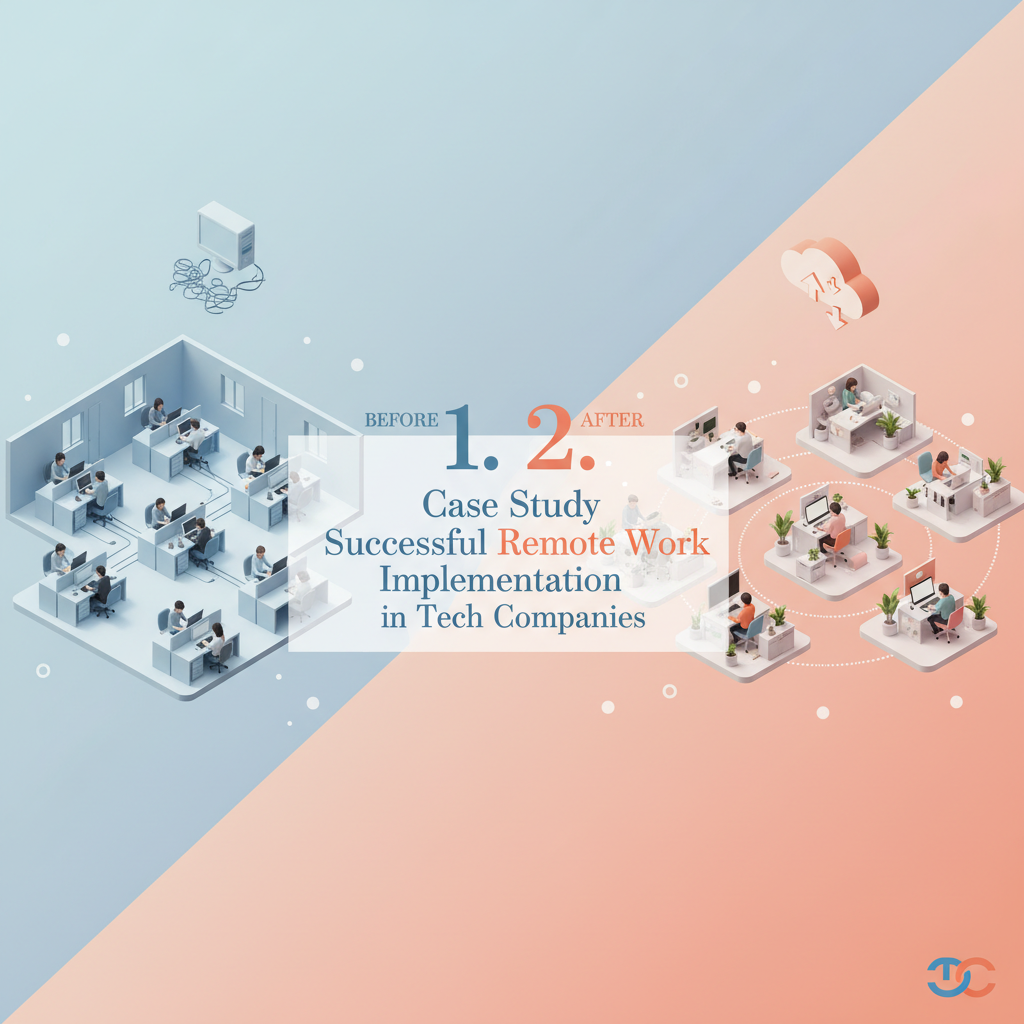
A product team can look sharp on paper and still fall apart the moment meetings, handoffs, and time zones spread out.
That is usually where a remote work case study gets interesting, because the real story is not the software stack.
It is how a company changes habits, expectations, and trust without slowing delivery.
Tech leaders keep running into the same tension: flexibility sounds easy until managers cannot see progress the old way.
According to Worktime’s 2026 remote work productivity data, results depend far more on clear systems than on constant visibility.
That is why some teams treat remote work implementation as a culture change, not a policy memo.
The strongest tech companies success stories usually share a blunt pattern.
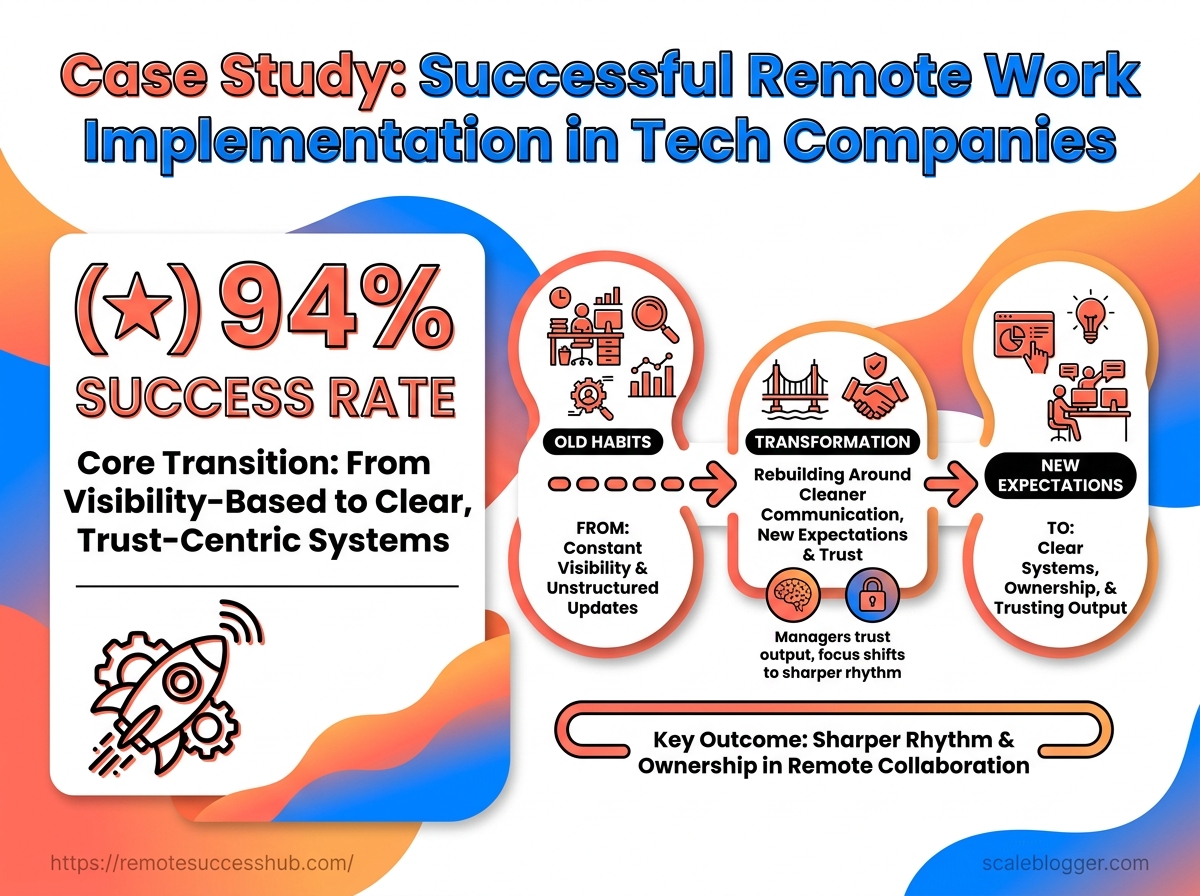
They stop copying office routines into video calls, then rebuild around cleaner communication, tighter ownership, and fewer pointless check-ins.
One engineering group can lose weeks to unclear updates; another can cut that drag fast once every role has a sharper rhythm.
That gap is where the useful lessons live.
A good case study shows what broke first, what was adjusted, and why the fix held up when pressure returned.
It is rarely glamorous.
It is usually a mix of discipline, patience, and a few hard-earned decisions.
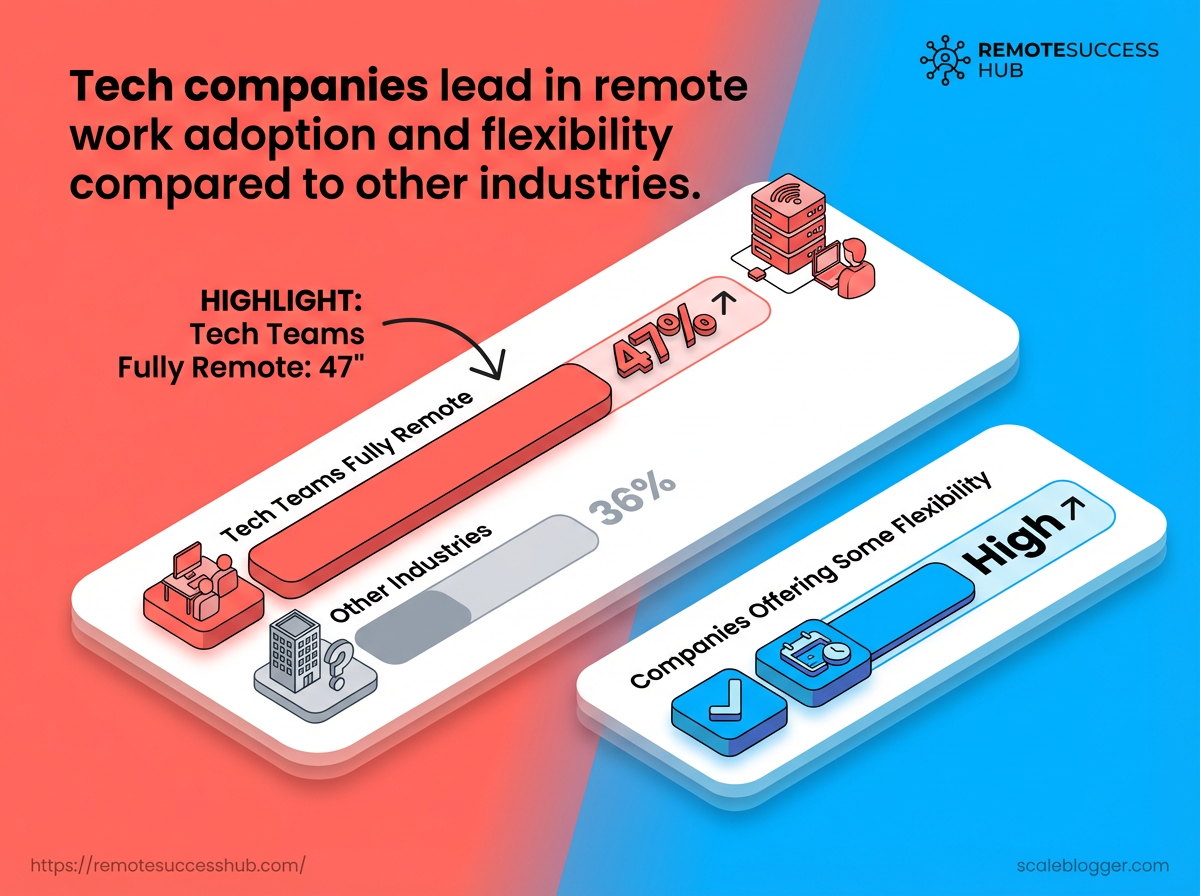
Quick Answer: Successful remote work implementation in tech companies comes from replacing office-style routines with clear systems for asynchronous communication, explicit handoffs, and measurable ownership—so managers can trust output instead of “visible activity.” Tech teams particularly benefit because they already operate in digital tools (Slack/Zoom/Jira), and performance is increasingly tracked by completion rates and delivery quality rather than online presence. According to Gable’s 2026 trends report, technology leads with 47% fully remote teams, showing the model can scale when expectations are rebuilt.
The Remote Work Shift Tech Teams Faced
The Monday stand-up did not just move rooms.
It moved onto Slack, Zoom, Jira, and a dozen other tabs, often in the same week.
That sudden shift changed the job in three big ways.
Communication became asynchronous, managers had to trust output more than visible activity, and the old office habit of “just swing by my desk” vanished almost overnight.
Tech companies adapted faster because their work was already digital.
According to Gable’s 2026 remote work trends report, technology leads with 47% fully remote teams, which is far above most industries.
Remote work also seems to have settled into a stable pattern across 2024 and 2025, rather than fading out, based on Robert Half’s remote work statistics and trends.
A lot changed once remote became the default.
Hiring widened beyond commute distance, onboarding had to be documented, and project handoffs needed sharper ownership.
Even performance tracking changed, because 2026 productivity data shows employers care more about output signals, meeting quality, and completion rates than simple online presence, according to WorkTime’s remote work productivity statistics for 2026.
Tech teams had a head start for a simple reason: their tools already lived online.
Code, tickets, docs, and releases were built for distributed work, while many other industries were still tied to physical processes and face-to-face coordination.
- Digital-first workflows: Engineers were already working inside version control, issue trackers, and cloud apps. That made the move less like a reinvention and more like a shift in location.
- Clear output metrics: Shipping code, fixing bugs, and closing tickets are easier to measure than many knowledge jobs. That helped tech managers adjust faster.
- Stronger async habits: Written updates, pull requests, and recorded demos reduced dependence on live meetings. This mattered when calendars got messy.
- Faster process cleanup: Teams that documented decisions early found fewer bottlenecks later. The remote work implementation felt smoother because the habits were already there.
By the end of 2025, 67% of companies still offered some flexibility, even as some moved back to office-heavy models, according to Founder Reports’ 2026 return-to-office statistics.
That tells the real story: remote work did not just change where tech teams sat.
It changed how they worked, measured progress, and built trust.
The shift to remote work didn’t succeed because teams “bought tools.” It succeeded because they defined the operating rules before people were forced to follow them.
In the best tech remote work case studies, the implementation model shows up as daily behavior—timing, ownership, and communication expectations—made repeatable across teams.
Timeline, ownership, and communication flow
| Phase | Primary goal | Key actions | Owner | Success indicator |
|---|---|---|---|---|
| Planning | Set the rules before the rollout begins | Define eligible roles, working hours, security requirements, and meeting norms; choose the core collaboration stack | Executive sponsor with People Ops and IT | Clear policy published, managers aligned, no major policy gaps |
| Pilot | Test the model with a small group | Launch with one or two teams, track response time, meeting load, and handoff issues, then fix friction fast | Team leads with an assigned project manager | Pilot teams meet deadlines and report fewer coordination problems |
| Full rollout | Expand without losing consistency | Roll out in waves, train managers, standardize weekly updates, and keep one source of truth for work tracking | Department heads with People Ops | Adoption stays steady across teams, support requests drop after launch |
| Optimization | Improve the system after launch | Review async habits, refine communication rules, reduce duplicate meetings, and update onboarding docs | Operations lead with managers | Faster decisions, fewer status meetings, better employee feedback |
Leadership sets the direction; managers translate it into daily practice; team leads surface the awkward gaps early (so they get corrected before they become “how we do things here”).
When ownership and handoffs are defined before the policy goes live, remote work implementation stops feeling improvised—and starts behaving like a system people can trust.
Remote work tends to slow down for a predictable reason: the work is split across too many places.
If chat, tasks, approvals, and decisions live in different systems, people either (1) wait for responses or (2) start re-asking the same questions—both of which create hidden delays.
The strongest tech remote work case studies converge on one principle: consolidate into one communication layer, one planning/tracking place, one documentation hub, and clear rules for when meetings are (and aren’t) needed.
That structure keeps work visible without turning every update into a meeting.
The collaboration stack and what each layer did
| Tool category | Common use case | Why it mattered | Example tools |
|---|---|---|---|
| Communication | Fast questions, status pings, incident updates | Kept response times low and work moving | Slack, Microsoft Teams |
| Project management | Task ownership, sprint tracking, deadlines | Made priorities and dependencies visible | Jira, Asana, ClickUp |
| Documentation | SOPs, decisions, onboarding notes | Reduced repeat questions and tribal knowledge | Notion, Confluence, Google Docs |
| Meeting management | Live decisions, 1:1s, screen shares | Reserved meetings for work that truly needed them | Zoom, Google Meet, Loom |
| Employee engagement | Recognition, pulse checks, manager feedback | Kept morale visible and problems from hiding | Bonusly, 15Five, Officevibe |
| File sharing | Shared assets, version control, access | Prevented attachment chaos and lost files | Google Drive, Dropbox, OneDrive |
| Scheduling | Time-zone coordination, booking links | Cut back-and-forth and calendar friction | Calendly, Google Calendar |
| Security and access | Account control, password management, permissions | Protected systems without slowing people down | Okta, 1Password, Google Workspace |
Communication handles urgency, documentation handles memory, and project boards handle ownership.
The policy layer matters just as much: when teams define response windows, meeting rules, and decision ownership, remote work implementation feels calmer—and performance tends to follow (fewer interruptions, clearer handoffs, and a setup people can actually stick with).
tickets isn’t the same thing as improving how work moves.
In a strong remote work case study, the real gains show up in retention, collaboration speed, and fewer ugly handoff problems—especially after the initial remote push settles into routine.
That’s when tech companies success becomes measurable.
According to Robert Half’s remote work statistics and trends, hybrid and remote work rates stabilized through 2024 and 2025.
That matters because it suggests leaders aren’t treating remote as a short experiment anymore—they’re managing it as a steady operating model.
The clearest productivity gains came from teams that measured beyond raw output.
They tracked cycle time, rework, response delays, and how often one blocked teammate slowed multiple others.
That gave them a cleaner read on performance than task counts alone.
> By the end of 2025, 27% of companies had returned to fully in-person models, while 67% still offered some level of flexibility, according to Founder Reports’ return-to-office statistics.
Flexibility also lined up with employee preference.
SurveyMonkey’s 2026 remote and hybrid work statistics shows that workers still value flexible arrangements—turning retention into a hard metric instead of a nice-to-have benefit.
The strongest leaders also watched collaboration quality, not just speed.
They asked whether decisions were made in one pass, whether new hires reached independence faster, and whether issues bounced between teams less often.
- Retention: Track regretted attrition, not just total headcount.
- Collaboration: Measure decision turnaround and handoff speed.
- Productivity: Watch cycle time, rework, and blocked work.
- Team health: Pair pulse surveys with manager observations.
Sector patterns mattered too.
Gable’s 2026 remote work trends notes that technology leads at 47% fully remote, with finance and insurance at 40%.
That kind of split helps explain why some teams saw faster gains than others.
The best results didn’t come from one magic number.
They came from a small set of signals that all pointed in the same direction.
When those numbers moved together, the remote model was working.
When remote work is working, you don’t notice it because someone is constantly “online.”
You notice it because decisions don’t stall, updates are easy to find, and teammates can pick up work without chasing context.
As remote and hybrid work stabilized, the differentiator became predictable communication and low-friction handoffs—backed by clear expectations.
The pattern is consistent in the data and in day-to-day execution: strong remote performers build a rhythm that makes their work easier to see and easier to support.
Build a system before you need one
A clean routine beats heroic bursts of effort.
The most reliable remote workers set a start time, a shutdown time, and one planning block that protects the day from drift.
- Plan the day in writing. A short morning list keeps priorities from getting buried under messages.
- Create visible handoffs. A quick update at the end of the day helps teammates move without waiting.
- Batch communication. Constant replies kill focus faster than most people realize.
That structure matches what tech teams optimized in remote work implementation: output that’s tied to results (not presence) and updates that reduce ambiguity.
Make your work easier to support
Support doesn’t appear out of nowhere.
It becomes possible when managers and teammates can see what’s blocked, what’s moving, and what’s done.
A simple weekly note often beats a long status meeting.
Say what changed, what needs input, and where the next decision sits.
Avoid the usual remote mistakes
The classic mistake is trying to look available instead of being effective.
Another one is working in silence until a problem becomes expensive.
- Over-communicating noise. Too many updates blur the real signals.
- Hiding blockers. Small delays become big ones when nobody can see them.
- Chasing tools over habits. Software helps, but routines carry the load.
Remote work rewards people who are predictable for the right reasons.
If you build that predictability, a remote work case study becomes more than reading—it becomes a set of behaviors you can repeat.
In remote roles, trust is the multiplier.
The person who can make their work easy to follow—clear decisions, documented output, dependable updates—tends to get opportunities faster than someone who only looks busy in meetings.
That career advantage matters because remote work is no longer a temporary experiment.
In 2026, flexible arrangements have stabilized, with Robert Half’s remote work statistics and trends showing the model has settled in, and Founder Reports’ 2026 return-to-office statistics noting that 67% of companies still offer some level of flexibility.
The career edge comes from compounding.
When your output is documented, your communication is clear, and your results are easy to trace, you become easier to trust across time zones and teams.
That trust turns into better projects, stronger references, and more room to negotiate the next role.
> In 2026, Worktime’s remote work productivity data points to a familiar pattern: remote performance improves when teams build systems that support focus, visibility, and accountability.
That is why this remote work case study fits neatly into a larger resource cluster.
The earlier sections covered implementation, tools, policies, and measurable outcomes; this one turns those mechanics into personal career leverage.
It’s the bridge between company success and individual growth.
For ambitious professionals, the practical move is simple:
- Track visible wins: Keep a running record of shipped work, solved problems, and decisions you influenced.
- Write like a teammate: Share updates that make follow-up easy, not mysterious.
- Reduce friction: Use systems that shorten handoffs and make your work easier to reuse.
- Show consistency: Reliability over time beats a few heroic sprints.
- Build portable proof: Save examples that travel with you into interviews or promotion reviews.
That is also where our remote work resources help most.
We focus on the everyday habits and systems that turn remote work from a location choice into career capital.
The real prize is not just working from anywhere.
It’s becoming the person people trust anywhere—which is a much stronger position to be in.
Turning Remote Work Into Repeatable Performance
The most useful lesson from this remote work case study is simple: the win came from designing the work, not just allowing it.
Tech companies success rarely comes from a policy memo; it comes from clear ownership, fewer handoff surprises, and documentation that keeps work moving after hours.
Once the team treated remote work implementation like an operating system, performance stopped depending on who happened to be online.
That matters because the biggest gains in the story were not abstract.
Better async communication, tighter meeting discipline, and cleaner project tracking improved delivery without asking people to work longer.
The same pattern shows up in strong remote teams everywhere: when the process is calm, the people can be fast.
If there is one move to make today, pick one recurring workflow and remove its weakest handoff.
Write down who owns it, what gets documented, and what can be answered asynchronously before the next meeting.
For any team shaping remote work implementation in a growing company, that small fix is often where the real momentum starts.