
Do your days blur into back-to-back video calls and long, quiet afternoons at the kitchen table?
That slow drift toward solitude can feel harmless, but it often isn’t.
Remote work can increase schedule flexibility while shrinking everyday social contact.
The scale is startling: a 2025 Mental Health Foundation study found 57% of remote workers felt more isolated than their in-office peers.
A 2025 Gallup report found 40% of remote employees experienced elevated anxiety or depression that year.
These figures link isolation directly to worsening mental health for a large share of the workforce.
Burnout followed: 2025 reports show roughly a 20% rise in burnout compared with pre‑pandemic levels.
All of this shifts how companies must think about remote workers’ mental health.
Buffer’s 2025 State of Remote Work found 29% of remote workers reported loneliness.
Some employers, including Google, responded with mindfulness, counseling, and peer groups.
Those are examples of employee support programs that can blunt the mental strain of isolation.
Table of Contents
Reframing Isolation: A What-If Start
What if isolation is the silent career limiter for ambitious remote professionals? Imagine missing small signals — a hallway compliment, an offhand direction, an informal sponsor — that quietly shape promotions and visibility.
That absence accumulates.
Over months it becomes fewer cross-team invites, weaker reputational currency, and slower access to stretch assignments.
Those are career outcomes, not just feelings.
Treating isolation as only an emotional problem misses the point.
It’s also structural: it reshapes how work flows, who gets favor, and which contributions get seen.
Reframing it that way creates solutions that protect career momentum, not just comfort.
Why silence can stall a career
Isolation reduces incidental interactions that generate informal endorsements.
Those micro-moments are where allies form and opportunities surface.
Remote work magnifies this.
Buffer’s State of Remote Work (2025) reported 29% of remote employees felt lonely, and a 2025 Gallup report found 40% experienced elevated anxiety or depression.
The Mental Health Foundation (2025) reported 57% of remote workers felt more isolated than office peers.
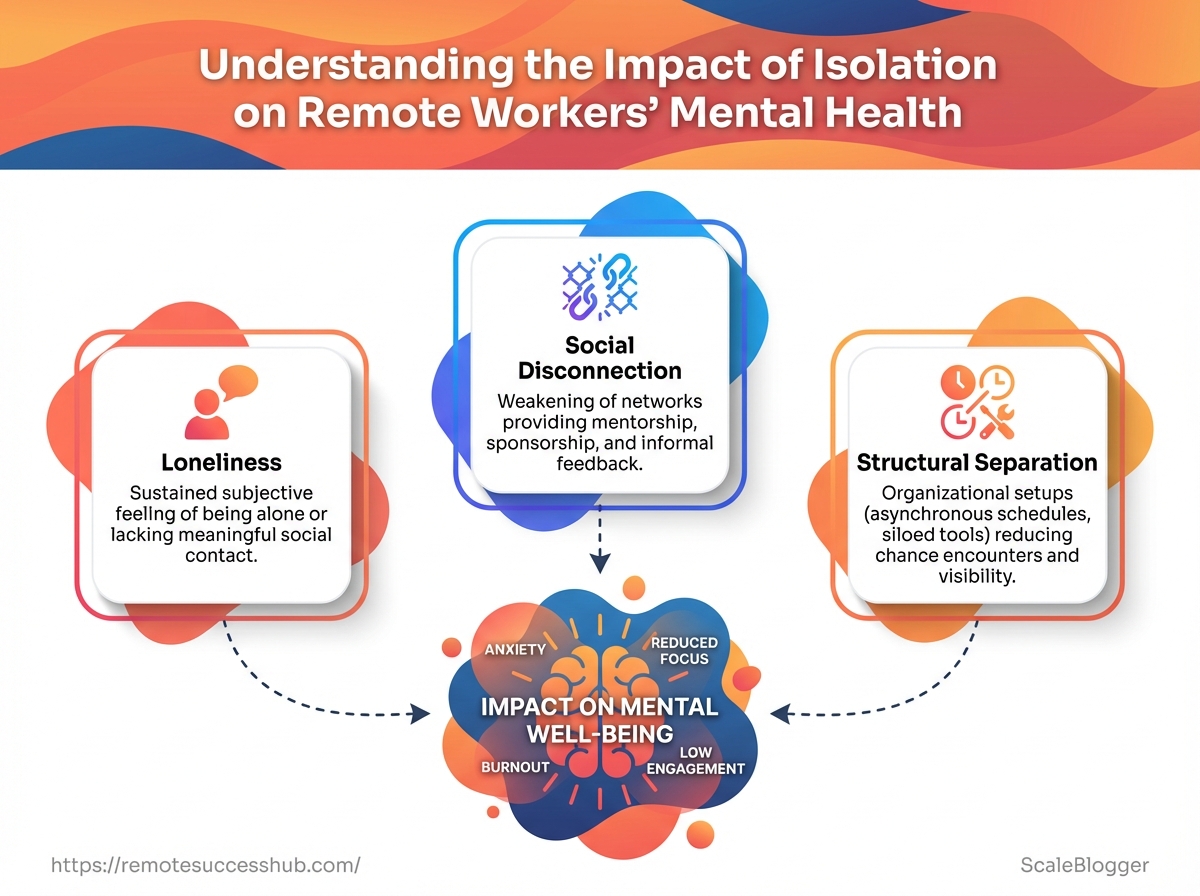
Those numbers show a pattern that affects both well-being and career mobility. Loneliness: A sustained subjective feeling of being alone or lacking meaningful social contact, even when work output remains steady. Social disconnection: Structural weakening of networks that provide mentorship, sponsorship, and informal feedback. Structural separation: Organizational setups — asynchronous schedules, siloed tools, distributed teams — that reduce chance encounters and visibility.
Practical micro-experiments to test the what-if
Weekly visible update: Post a concise project highlight each Friday to create predictable visibility and invite feedback.
Two-minute check-ins: Ask for a 2-minute “quick brainstorm” instead of formal meetings to recreate hallway moments.
Sponsor mapping: Identify one senior colleague to brief monthly; treat it as a sponsorship pilot.
Cross-team office hours: Host one hour per month labeled for quick help on a specific topic.
Microsoft, LinkedIn, and Google expanded employee support and wellbeing programs to address isolation — Google’s Wellbeing efforts include counseling and peer support — which shows employers can close these gaps at scale.
Try one small experiment this week and measure a real signal: a new connection, an invite, or a piece of feedback.
It changes how isolation functions and how your career moves forward.
How Isolation Physically and Psychologically Manifests
Have you noticed small shifts in energy, focus, or mood that didn’t feel like normal busywork? Those little changes are often the earliest signs that isolation is moving from an occasional nuisance into a pattern that affects both body and mind.
Remote work can produce immediate changes—restless nights, midday fatigue, or heightened worry—that pile up if left unaddressed.
In 2025, a Gallup report found 40% of remote workers experienced elevated symptoms of anxiety and depression, and the Mental Health Foundation reported 57% of remote employees felt more isolated than office peers.
Those numbers map directly onto daily experiences: missed meetings, shrinking participation, and creeping errors.
Physical symptoms and psychological patterns feed one another.
Companies such as Google have added wellbeing programs—counseling, mindfulness, peer groups—to blunt those effects, but recognition at the individual level matters just as much. When remote professionals learn to read the signals, they can triage the problem before it becomes chronic.
Physical manifestations
Physical signs often come first because stress translates into the body more quickly than into clear thoughts.
Sleep disruption: Difficulty falling or staying asleep, early waking, or non-restorative sleep.
Somatic complaints: Headaches, neck or back tension, and gastrointestinal upset without a clear medical cause.
Energy swings: Midday crashes, morning sluggishness, or jittery caffeine dependence.
Appetite changes: Eating significantly more or less than usual, or craving high-sugar foods for quick energy.
These symptoms are not just personal discomfort; they reduce cognitive bandwidth and raise the odds of burnout over time.
Psychological patterns and workplace signals
Mental patterns tied to isolation shift behavior before they become diagnosable conditions.
Low mood / anhedonia: A flattening of enjoyment in work tasks, hobbies, or social contact.
Increased anxiety / worry: Persistent tension about performance, meetings, or perceived judgment.
Cognitive fog: Trouble sustaining attention, following threads in async conversations, and making decisions.
Decreased motivation: Task avoidance, longer ramp-up time, and missed voluntary projects.
Social withdrawal: Fewer chat messages, skipping video calls, and declining collaborative offers.
Buffer’s 2025 State of Remote Work reported 29% of remote workers felt lonely, which often shows up as reduced collaboration long before someone asks for help.
Short- and long-term mental health effects linked to isolation
Comparison of common symptoms, likely duration, and workplace signals
Symptom or Sign | Short-term manifestation | Long-term risks | Workplace performance indicators | Suggested immediate action |
|---|---|---|---|---|
Low mood / anhedonia | Persistent sadness, reduced pleasure in tasks | Clinical depression, sustained disengagement | Lower quality output, fewer proactive contributions | Schedule a brief check-in with a manager; try small, rewarding micro-tasks |
Increased anxiety / worry | Racing thoughts, restlessness, sleep problems | Generalized anxiety disorder, panic episodes | Over-preparation, missed deadlines due to overchecking | Practice grounding exercises; consult EAP or a counselor |
Cognitive fog / reduced concentration | Difficulty focusing, forgetfulness | Chronic executive dysfunction, reduced learning capacity | Frequent errors, slow decision-making, missed subtle cues | Use time-blocking, single-task sprints, and short breaks every 50 minutes |
Decreased motivation / disengagement | Procrastination, fewer voluntary efforts | Dropped initiatives, lower visibility in team outcomes | Break projects into 20–45 minute tasks; set visible micro-deadlines | |
Social withdrawal / reduced collaboration | Decline in chat activity, avoiding calls | Weakened professional networks, stalled promotions | Lack of cross-functional work, fewer referrals | Recommit to one recurring synchronous meeting; send a quick status message to the team |
This table translates symptoms into actionable cues.
Recognizing patterns early lets you pick a short-term response that reduces the chance of longer-term harm.
Practical awareness prevents small problems from becoming career-limiting ones.
Notice the body signals, link them to behavior at work, and act quickly — the sooner you respond, the easier the fixes become.
If you want peer-tested strategies and templates for quick check-ins or energy resets, platforms like https://remotesuccesshub.com/ offer community-shared tools and example scripts you can adapt.
Impact on Productivity, Career Growth, and Professional Identity
Have you ever felt like hard work goes invisible when the office disappears? Isolation quietly eats the everyday interactions that create credit, mentorship, and serendipitous learning — and that loss shows up as slower promotions, fewer stretch assignments, and stalled skill growth.
The real mechanism runs on two tired currencies: cognitive bandwidth and social currency.
When people are isolated, they spend more mental energy managing logistics and emotional load, leaving less capacity for proactive career-building.
At the same time, fewer informal touchpoints mean fewer chances to be seen doing high-impact work.
Those patterns show up in the data.
A 2025 Mental Health Foundation study found 57% of remote workers felt more isolated than office peers, and Buffer’s State of Remote Work 2025 reported 29% felt lonely.
Gallup’s 2025 report linked remote work to higher anxiety for 40% of respondents.
Companies such as Google, Microsoft, and LinkedIn have introduced wellbeing and development programs to address this, but organizational fixes rarely restore the small signals that drive promotions.
Platforms like https://remotesuccesshub.com/ can help rebuild visibility systems in practical ways.
How isolation undermines visibility, opportunities, and skill development
Isolation strips away the small moments that compound into career momentum.
Without them, achievements are less likely to be noticed, learning slows, and access to high-visibility projects shrinks.
Reduced micro-visibility: Small wins shared in passing no longer happen, so outcomes lack social proof.
Fewer spontaneous stretch opportunities: Managers assign riskier tasks through informal trust built in casual interactions.
Skill atrophy from fewer peer demos: Learning from hallway demos, quick code reviews, or shadowing disappears.
Delayed feedback loops: Longer feedback cycles mean mistakes persist and development stalls.
Networking drag: Building advocates requires repeated low-stakes contact that isolation interrupts.
Signals managers notice — and the ones they miss
Managers pick up on concrete deliverables and meeting presence.
But they often miss the quieter cues that predict growth potential.
Noticed: Consistent delivery — meeting deadlines and clear outputs get rewarded quickly.
Noticed: Meeting participation — visible engagement during synchronous calls.
Missed: Micro-initiation — small offers to help that signal leadership appetite.
Missed: Cross-team rapport — unobserved social capital that leads to sponsorship.
Missed: Informal learning signals — brief peer teaching moments that indicate rising capability.
The flowchart above maps the chain from isolation to stalled progression: isolation reduces cognitive bandwidth, which cuts networking and visibility, which lowers sponsorship and promotion chances.
Use that pathway to target the weakest link in your environment.
Isolation doesn’t doom a career, but it reshapes which actions actually move the needle.
Take small, repeatable steps to rebuild visibility and stretch opportunities so effort converts back into advancement.
Risk Factors and Who Is Most Vulnerable
Have you noticed certain people in your org seem to drift away faster than others? Patterns show that isolation doesn’t affect everyone equally.
Some situations and life stages create deeper vulnerability, and spotting those early makes targeted support possible.
This section flags the highest-risk conditions and the personal profiles that tend to suffer most.
It connects each risk to concrete signals managers can watch for and small fixes that reduce the danger without heavy policy changes.
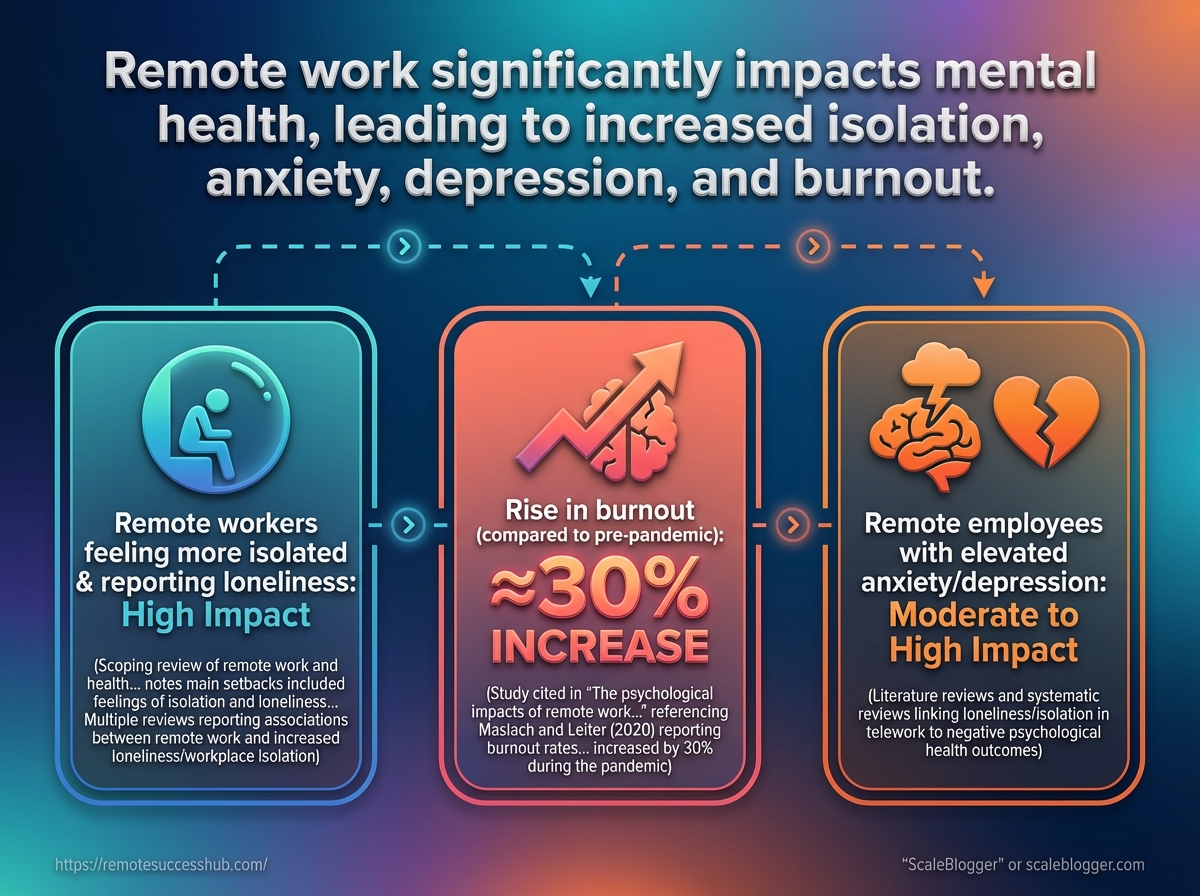
57% of remote workers reported feeling more isolated compared to office peers (2025).
40% of remote workers experienced elevated symptoms of anxiety and depression in 2025.
Situational risk factors
People working across large time differences, occupying solo roles, or who just joined remotely face the steepest hurdles.
Timezone mismatch can erase chances for spontaneous collaboration.
Solo roles lack built-in social touchpoints that reveal problems early. Timezone mismatch: Teams split across many hours create chronic misalignment with core team rhythms. This reduces informal contact and slows feedback loops. Solo roles: When a single person owns a function, their work is visible only in deliverables, not in daily touchpoints.
They miss the friction that builds relationships. Recent hires: New employees onboarded remotely often miss patterned interactions that signal belonging.
That accelerates detachment before they’ve built social capital.
Early signal — Missed informal check-ins or short response lags during overlap hours.
Quick mitigation — Protect at least two hours of weekly synchronous overlap for new or solo hires.
Demographic and life-stage vulnerabilities
Certain personality types and life demands make isolation worse.
Introverts may prefer solitude but also lose the small social calibration that prevents career drift.
Caregivers juggle unpredictable demands and often opt out of optional socials. Introverts: Comfortable working alone but deprived of micro-affirmations that sustain confidence. Caregivers: Time-constrained and likely to miss rituals that create visibility. Early-career professionals: They depend on mentorship and micro-feedback to learn role norms and build networks.
Early signal — New hires or junior staff stop volunteering in meetings or stop asking career questions.
Quick mitigation — Pair early-career staff with two rotating mentors, one cross-functional.
Organizational signals of elevated risk
Some company practices quietly amplify isolation.
Weak onboarding, few social rituals, and no structured synchronous hours are red flags.
These are organizational levers that can be changed without big budgets. Poor onboarding: Onboarding that focuses only on tools and tasks but not social maps leaves people unmoored. Sparse social rituals: No recurring low-effort events removes the scaffolding that sustains connection. Unclear expectations for overlap: When teams never agree on core hours, many employees self-isolate.
Early signal — High voluntary attrition among remote roles within the first 12 months.
Quick mitigation — Document social maps and schedule lightweight rituals; platforms like https://remotesuccesshub.com/ offer templates and checklists that make this easier.
Spotting who’s most vulnerable lets managers act before stress becomes a crisis.
Small, consistent changes to schedule, onboarding, and rituals protect people without overhauling the whole remote model.
Employer Strategies: Building Supportive Systems
Who at your company notices when someone drifts quiet on Slack? Employers must treat that sightline as a structural problem, not a personal one.
Companies that build predictable processes for connection and detection reduce the risk that talented people vanish from career sightlines.
Practical policies—structured onboarding, formal mentorship, scheduled social rituals—create repeatable opportunities for relationship-building.
Managers need matching practices: a reliable cadence of meaningful 1:1 check-ins, public recognition that preserves optics, and low-friction ways for people to ask for help without fear.
These systems make isolation measurable and fixable rather than mysterious.
The need is urgent: remote work surveys show elevated mental health challenges.
In 2025, the Mental Health Foundation found 57% of remote workers reported greater isolation, and Gallup reported 40% experienced elevated anxiety or depression the same year.
Companies such as Google have already expanded wellbeing programs, and Buffer’s 2025 findings highlighted loneliness as a persistent issue.
Designing policies that reduce isolation
Create a structured onboarding roadmap that pairs task milestones with relationship milestones so new hires meet teammates across functions in their first 90 days.
Launch a formal mentorship program with clear time commitments (e.g., 6-month match, monthly check-ins) and explicit goals like visibility or career planning.
Schedule recurring, low-pressure social rituals—such as “team coffee” and interest-based microgroups—with rotating hosts and optional attendance.
Make office hours and cross-team buddy systems part of role descriptions so relational work isn’t optional or invisible.
Practical manager actions: cadence, check-ins, optics
Managers should treat cadence as a tool, not a habit.
Keep 1:1 frequency consistent and use open-ended, non-leading prompts that surface isolation without forcing disclosures.
This short video provides three scripted 1:1 templates and non-leading questions managers can use to surface early signs of isolation and burnout.
Use the scripts as a baseline and adapt to your team’s tone.
Regular cadence: One weekly 1:1 and one monthly development conversation to separate task triage from career signals.
Non-leading prompts: Ask about recent small wins, energy levels, and connection points rather than mental health labels.
Positive optics: Publicly celebrate contributions in team channels to ensure credit and presence are visible.
Measuring success: KPIs and signals to track
Track both participation and wellbeing signals, not just outputs.
Useful KPIs include:
Participation Rate: Percent attendance in optional socials and knowledge-sharing sessions.Engagement Score: Pulse survey items on belonging and access to collaborators.Retention: Voluntary turnover trends for remote roles versus in-office roles.eNPSand pulse shifts: Short surveys that detect directional movement in sentiment.Mentorship reach: Percent of employees with active mentor matches.
Platforms like https://remotesuccesshub.com/ can help centralize pulse surveys and mentorship metrics alongside engagement dashboards.
Small design changes protect careers and wellbeing.
Make connection an explicit part of work, measure it, and hold managers accountable for the relational fabric of their teams.
📥 Download: Download Template (PDF)
Individual Strategies for Remote Professionals
Are you juggling meetings, email, and the quiet drag of days that blend together? Build a short-term toolkit that protects your mental bandwidth and keeps your work visible without burning out.
Treat routines like scaffolding: small, repeatable rituals reduce decision fatigue and make social connection predictable.
Add a few deliberate visibility habits so achievements don’t vanish into the ether.
Expect a gradual payoff.
The goal is steady adjustments you can keep for months, not dramatic weekly overhauls.
Protecting mental bandwidth: daily routines and boundaries
Start each day with a tiny anchor.
A 10-minute planning block and a brief walk reset focus and reduce reactive work.
Use calendar-level boundaries to protect attention.
Block two deep-work sessions, plus a 30‑minute “social check-in” each day to prevent total isolation.
Morning anchor: Plan priorities in 10 minutes and set 3 non-negotiables.
Time-boxed work: Reserve
deep-workslots and label them busy on your calendar.Transition ritual: End the workday with a 5-minute tidy and a status note to close the loop.
Networking and visibility techniques for career momentum
Visibility is an everyday habit, not a quarterly scramble.
Small, consistent moves accumulate into reputation.
Schedule lightweight public wins and narrate them.
Share short postmortems after projects, volunteer for demos, and ask managers for one visible task per quarter.
Weekly status share: Post a 3-line update in team channels so work doesn’t get lost.
Micro-mentoring: Offer short help sessions to peers to stay connected and seen.
Cross-team demos: Present a 5-minute demo quarterly to broaden your audience.
Community participation: Join platforms like Remote Success Hub to meet other remote pros and swap tactics.
Practical checklist: immediate actions to reduce isolation
Quick checklist you can use now
Action | Timeframe | Why it helps (mental health / career) | Difficulty (low/med/high) | Quick tips |
|---|---|---|---|---|
Schedule a 1:1 coffee with a colleague | 24 hours | Restores social connection; builds sponsorship | Low | Propose 20 minutes; have one work question ready |
Join or start a focused interest channel | 1 week | Provides repeatable social touchpoints; raises profile | Low | Pick niche topic and seed 2 weekly posts |
Block deep-work and social time in calendar | 24 hours | Protects attention; prevents reactive isolation | Low | Color-code blocks and share availability |
Ask manager for a development visibility task | 1 week | Creates measurable exposure; supports career growth | Medium | Suggest a small cross-team deliverable |
Sign up for a peer mentorship session | 1 month | Reduces loneliness; builds reciprocal networks | Medium | Rotate with peers to keep commitment low |
Run a short lunchtime demo for team | 1 week | Demonstrates competence; invites feedback | Medium | Keep to 10 minutes and record it |
Join an external cohort or workshop | 1 month | Expands network and learning; combats echo chambers | High | Choose one with active discussion forums |
Create a weekly “wins” note to stakeholders | 24 hours | Keeps accomplishments visible; reduces credit loss | Low | Use 2–3 bullets and share consistently |
Set a weekly social goal (1 new contact) | 1 week | Forces outreach habit; increases opportunities | Low | Use brief Slack intros or LinkedIn messages |
Schedule a monthly check-in with a mentor | 1 month | Sustains long-term career support | Medium | Book recurring slots in advance |
This checklist prioritizes quick wins you can do within a day, plus sustained habits for the month ahead.
Use the calendar and tiny rituals to turn one-offs into steady social signals.
Consistent, small actions beat occasional grand gestures.
Start with one 24-hour item and build outward; momentum compounds faster than you expect.
Measuring, Monitoring, and Iterating Support
Have you ever wondered which small signals actually predict someone drifting away from the team? Measuring support for remote employees isn’t about surveillance.
It’s about lightweight, regular checkpoints that surface changes early enough to act.
Start with repeatable, low-friction data and pair it with qualitative observation.
That mix lets teams detect trends without turning every interaction into a performance metric.
It also makes escalation cleaner when professional help is needed.
This approach matters: remote work has measurable mental health impacts.
For example, a 2025 Gallup report found 40% of remote workers experienced elevated anxiety or depression symptoms, and the Mental Health Foundation reported 57% felt more isolated in 2025.
Those numbers justify a clear monitoring-to-escalation pathway.
Buffer’s State of Remote Work (2025) reported 29% of remote workers felt lonely, underscoring why routine check-ins must be intentional.
Low-friction monitoring techniques for teams
Low effort beats no effort.
A weekly pulse that takes 30 seconds will find problems before they grow.
Weekly pulse surveys: one to three questions, anonymous option; sample
questions:How connected did you feel to the team this week? (1–5);Any blockers affecting your focus?Participation metrics (contextual): track meeting attendance and voluntary contributions, not camera-on policing.
Look for sustained drops over 2–4 weeks.
Async signal sampling: monitor changes in tone or message length in Slack or email threads as a trend, not a one-off.
Micro–retention cues: onboarding follow-up response rates and project hand-off delays can flag disengagement early.
Well-being NPS: a quarterly
How supported do you feel? (0–10)gives a team-level trendline without being intrusive.
Using qualitative signals: anecdote patterns and manager observations
Quantitative flags need human sense-making.
Managers’ notes and peer anecdotes fill gaps charts can’t.
Keep a simple observation log for one-on-ones: date, behavior noticed, brief quote, next step. That habit turns vague worries into reliable patterns.
Language shift: shorter messages, fewer jokes, or repeated cancellations.
Work product changes: missed deadlines or more review cycles than usual.
Social drop-off: declining attendance at optional socials or mentoring chats.
Manager intuition: document hunches and test them with a short check-in rather than assuming.
When to escalate: connecting employees to professional support and benefits
Escalation needs rules and a low-friction path to help. Use a simple threshold: sustained concerning signals for 2–4 weeks or any sign of functional decline triggers next steps.
Privately confirm observations in a one-on-one and offer immediate support options.
If concerns persist, connect the employee to the benefits team or Employee Assistance Program (EAP).
Offer curated external resources and flexible workload adjustments while they access care.
Follow up weekly until the person reports stable improvement.
Immediate referral: Employee Assistance Program or internal counseling channel.
Peer-supported options: facilitated peer groups or moderated team check-ins (example: Google Wellbeing–style peer support).
External care: clear info on how to access therapy through insurance or stipends.
A small script helps managers open the door: “I’ve noticed X and want to make sure you’re supported.
Would you like me to connect you with HR or an EAP counselor?” Use compassionate clarity and offer choices.
Platforms like https://remotesuccesshub.com/ provide pulse templates and sample observation logs that make starting easier.
Detecting early, documenting carefully, and having a clear escalation lane keeps people safe and teams healthy.
Small, routine measures let support evolve instead of waiting for crisis.
Conclusion
Designing effective systems greatly matters in combating remote loneliness. Isolation among remote workers not only manifests physically, such as disrupted sleep and headaches, but it also adversely impacts professional identity and career mobility. This calls for comprehensive organizational strategies—rather than mere motivational talks—such as consistent manager check-ins, clear communication norms, and systematic evaluations of employee engagement to detect mental health issues early. By addressing solitude as an operational risk, teams can proactively identify challenges and implement targeted interventions.