
What if the biggest shift in work is not about office space, but about control? That is where the future of remote work is heading.
Teams are no longer asking whether remote work exists; they are asking how much flexibility still works when performance, trust, and culture all matter.
That question matters because the market is already split.
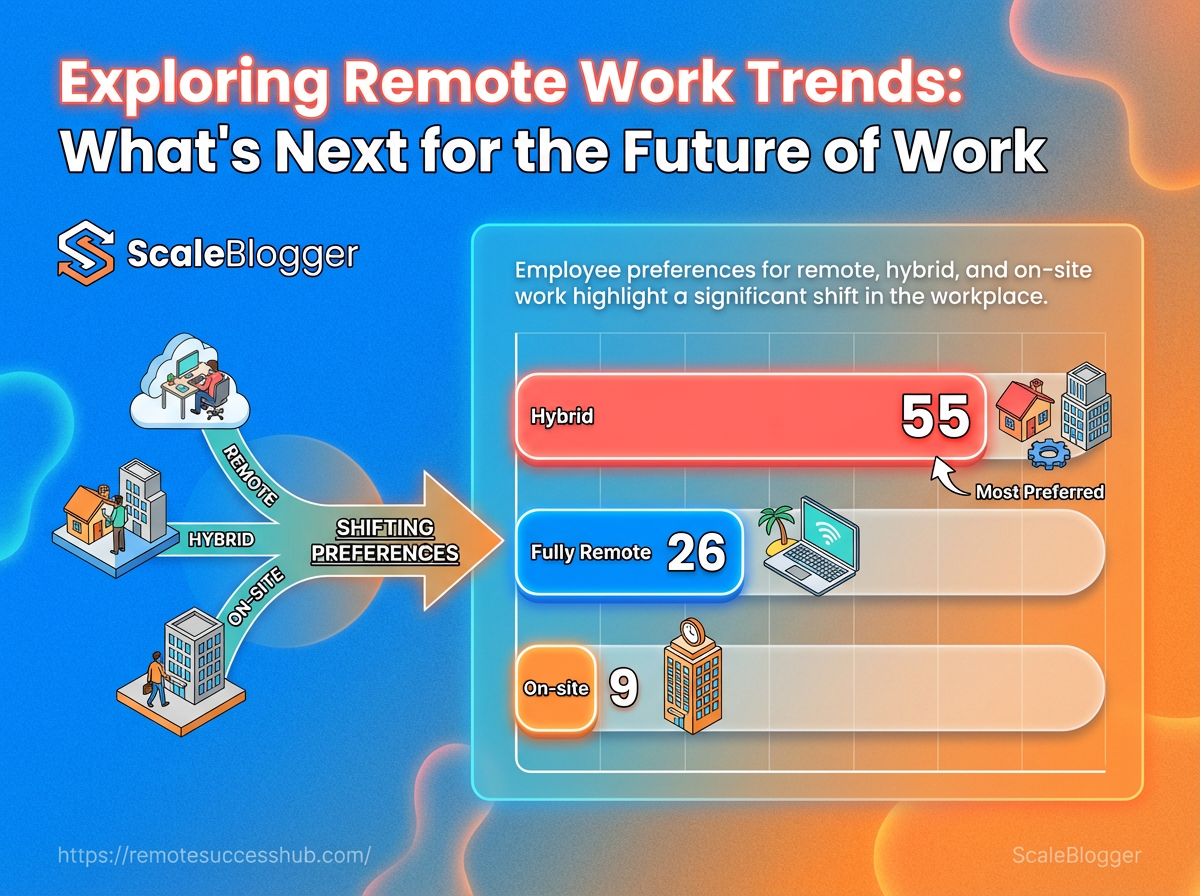
Gallup reports that six in 10 employees with remote-capable jobs want a hybrid arrangement, while about one-third prefer fully remote work, and fewer than 10% want to be on-site (Gallup’s hybrid work indicator).
Those numbers point to a wider workplace evolution.
Employers are tightening policies, employees are protecting flexibility, and the old one-size-fits-all office model keeps losing ground.
The result is a messy middle, where remote work trends change faster than many teams can update their rules.
That tension is exactly why the conversation feels so charged.
The next phase will not be about choosing remote or office like a team jersey; it will be about designing work that actually fits the job, the people, and the business.
Quick Answer: Remote work is becoming the default because employees with remote-capable jobs overwhelmingly want flexibility—Gallup’s hybrid-work data consistently shows most people prefer hybrid or fully remote arrangements, with only a small minority preferring on-site work. The next phase of work models will shift from location-first to outcome-first, with hiring, management, and performance expectations built around autonomy, trust, and measurable output rather than proximity.
What if remote work is not the exception, but the default?
The office may no longer be the center of gravity—it’s becoming just one option among many. That shift already looks less like theory and more like a market signal.
Gallup’s latest Global Indicator: Hybrid Work shows that, among employees with remote-capable jobs, most prefer hybrid or fully remote arrangements, while a small minority prefer on-site work.
That is a loud signal for flexibility.
The workplace is changing from location-first to outcome-first
Remote-first expectations are reshaping hiring, not just schedules.
FlexJobs reported that remote job postings rose 20% over Q4 2025 in its Remote Work Index, and that kind of growth signals where employers are still trying to compete for talent.
At the same time, there is a gap between worker demand and what many employers still offer.
A recent LinkedIn Pulse analysis on remote work in 2026 noted that only 7% of listings are hybrid and just 6% are fully remote, which helps explain why strong candidates keep shopping around.
The future of remote work is not about working in pajamas.
It is about a workplace evolution where autonomy, trust, and measurable output matter more than proximity.
Ambitious remote professionals should read this as leverage
That shift creates room for people who can show discipline without supervision.
The best remote professionals are not just available; they are easy to trust, simple to collaborate with, and strong at visible delivery.
Robert Half’s remote work statistics and trends for 2026 found that 38% of professionals were already looking or planning to look for a new role in the first half of 2026, which tells you how active the talent market still is.
When flexibility becomes a priority, skill alone is not enough; positioning matters too.
A smart response looks like this:
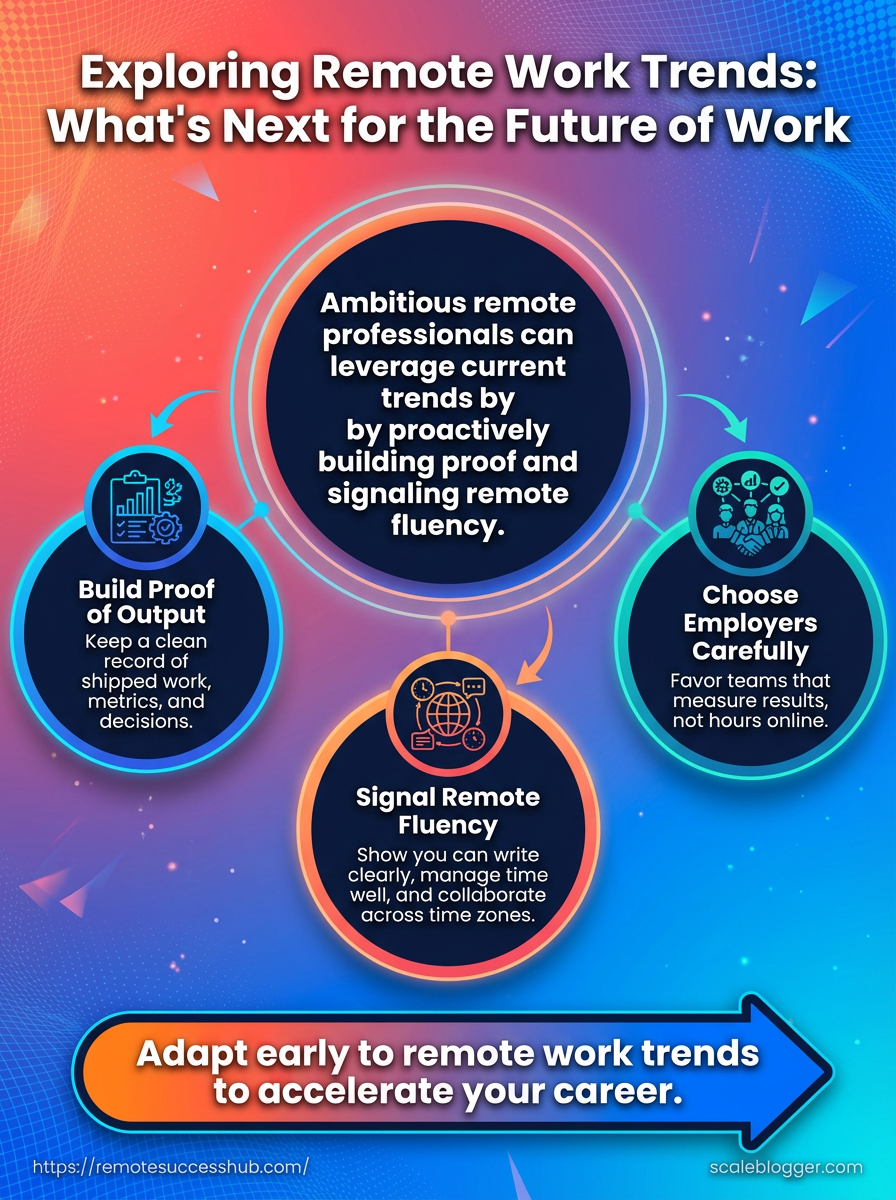
- Build proof of output: Keep a clean record of shipped work, metrics, and decisions.
- Signal remote fluency: Show you can write clearly, manage time well, and collaborate across time zones.
- Choose employers carefully: Favor teams that measure results, not hours online.
That is the real opportunity here.
People who adapt early will not just keep up with remote work trends; they will use them to move faster than everyone else.
The remote work trends defining the next phase of workplace evolution
Remote-work trends are converging on a practical question: how decisions get made and performance gets judged.
Flexible schedules are giving way to defined operating rhythms
The days of “be flexible” as a vague perk are fading. Teams are increasingly replacing open-ended availability with clear collaboration windows, expected response norms, and role-specific boundaries.In practice, this shows up as:
- fewer blanket expectations about when you’re online
- more explicit rules for meeting windows, handoffs, and escalation
Hybrid is becoming a policy choice, not a compromise
Hybrid planning is getting more deliberate—teams treat it as a system.Instead of “some people come in sometimes,” strong hybrid setups define:
- which days matter (if any)
- what work requires synchronous time vs. async execution
- how calendars, priorities, and communication are aligned
How performance expectations are shifting
The old model rewarded visibility. The new model rewards clarity and follow-through.In hiring and internal reviews, that typically means you’re assessed on:
- whether outcomes are delivered predictably
- whether communication reduces rework
- whether collaboration quality stays high without constant presence
Remote work trends are moving toward structure that protects focus and makes progress measurable—so the teams adapting fastest are the ones who write the rules down and measure work by outcomes everyone can see.
What remote professionals need to thrive as work models evolve
Remote performance is moving toward reliability that doesn’t require constant supervision.
That’s where remote work is heading: toward outcomes people can trust, without demanding constant presence.
The skills that separate steady performers
The most valuable remote skill still isn’t “being online a lot.” It’s clear judgment.People who can define the real problem, write decisions down, and keep work moving without unnecessary meetings are becoming harder to replace.
Across distributed teams, three skills keep widening the gap:
- Written clarity: short, specific updates beat vague pings.
- Asynchronous collaboration: you don’t wait for perfect overlap; you make progress with partial information.
- Priority discipline: you spot noise fast and protect the work that actually matters.
Visibility now looks like proof, not presence
Being visible remotely is less about your status and more about whether your work leaves a usable trail.If your contributions are:
- easy to find
- easy to review
- easy to build on
Where productivity breaks down—and how to fix it
Remote productivity usually fails in the gaps between steps, not in the work itself.- Planning slips: goals stay fuzzy, so work gets busy instead of useful.
- Execution drifts: long stretches without checkpoints make small issues grow.
- Review stalls: feedback arrives late, creating rework.
- Coordination breaks: people assume someone else owns the next move.
The fix is “boring,” which is why it works:
- Run a short weekly plan that turns goals into next actions.
- Write decisions in one place so context doesn’t vanish.
- Set response-time norms (so urgency is consistent).
- Close projects with a brief review of what slowed things down.
The remote advantage isn’t independence—it’s repeatable coordination.
If you make your work obvious, useful, and easy to trust, you build credibility that travels.
Tools, systems, and habits that support long-term remote career growth
A laptop and decent Wi‑Fi can get you started.
They don’t build a career that keeps moving.
Remote professionals who grow fastest tend to make their work easy to understand, easy to trust, and easy to improve.
Clarity is the real advantage. Tools should remove drag—not add it. If your workflow requires constant reminders, scattered screenshots, and “where did we leave off?” rituals, you’re paying a hidden career tax.
A remote work setup checklist for career momentum
Use this to audit how reliably your communication, focus, visibility, and learning show up day after day.| Category | What Good Looks Like | Why It Matters | Self-Rating |
|---|---|---|---|
| Communication | Clear updates and fast context sharing | Prevents misunderstandings and delays | 1–5 |
| Focus | Protected deep work blocks and task prioritization | Improves output quality and consistency | 1–5 |
| Career visibility | Documented wins and regular stakeholder updates | Supports promotions and opportunities | 1–5 |
| Learning | Ongoing skill development and feedback loops | Keeps pace with workplace evolution | 1–5 |
- Where do messages break down?
- Where does attention leak?
- Where do your best results disappear into the void?
A toolkit that actually helps
- Communication hub: Use one primary place for team updates, decisions, and follow-ups. Fewer scattered threads = fewer lost details.
- Task system: Keep one trusted list for priorities, deadlines, and next actions. If work lives in five places, urgency becomes noise.
- Meeting notes ritual: Capture decisions, owners, and deadlines in the same format every time. Consistency lowers coordination cost.
- Learning log: Track what you practiced, shipped, or improved each week. It makes growth visible when performance reviews arrive.
- Energy reset habit: Block short breaks and close the day with a shutdown routine. Remote careers last longer when burnout doesn’t quietly accumulate.
The best setup isn’t the fanciest one.
It’s the one that keeps your work visible, your focus protected, and your next move obvious—so your career momentum survives whatever workplace evolution shows up next.
How companies are adapting, and what that means for your career path
What if the companies that win remote talent aren’t the ones with the loosest setup—they’re the ones with the clearest rules?
That’s the shift showing up across remote work trends: teams are moving from “flexible when we can” to “structured by default.”
Policies that shape opportunity (quietly)
A remote policy can look harmless until it starts deciding:- who gets visibility
- what gets promoted
- what kind of work gets prioritized
The healthiest teams make those rules plain.
Remote-friendly companies tend to do things like:
- write down how decisions get made and what good performance looks like
- define when collaboration should happen synchronously vs. asynchronously
- stop treating proximity as a proxy for commitment
You can often spot the difference in three areas:
- Promotion criteria: advancement depends on outcomes, not who dominates meetings.
- Meeting discipline: fewer meetings, better agendas, and clear notes make work easier to follow.
- Manager training: leaders learn to coach through text, video, and async updates—not just live.
Support systems matter more than slogans
A distributed team can sound great on paper and still feel lonely in practice.Companies built for sustainable growth invest in career infrastructure such as:
- onboarding that explains how work gets done (not just where files live)
- mentoring and feedback loops that help you learn the team’s “way of working”
The best signal of all is simple: the company’s remote setup makes your growth easier, not harder.
If the future of remote work keeps moving this direction, your best career bets will come from teams that build for trust, clarity, and long-term momentum.
Positioning yourself for the next stage of the future of remote work
A job market can move faster than any yearly review cycle.
That’s why you shouldn’t treat remote work trends as headlines. Treat them as a planning tool.
The sharpest career move is to align your skills and proof points with where demand is moving next—before everyone else notices.
Read the market before it reads you
Remote careers reward people who spot patterns early.Instead of asking only “Is hiring happening?” ask:
- Which role clusters are being supported with remote workflows?
- Which skills repeatedly show up in job expectations?
- What evidence do top candidates tend to provide (examples, outcomes, artifacts)?
A practical approach:
- Track role clusters: watch which departments keep hiring remotely and what responsibilities they emphasize.
- Add one adjacent skill: choose a capability that travels across teams (e.g., async project writing, stakeholder management, or structured problem solving).
- Collect proof, not just experience: maintain a living portfolio of launches, fixes, and process improvements.
Avoid the traps that slow ambitious people down
A lot of strong remote professionals get stuck by chasing visibility instead of leverage.Common traps:
- Over-optimizing status: being seen isn’t the same as being trusted.
- Ignoring time-zone friction: slow replies and unclear handoffs quietly damage momentum.
- Networking only upward: peers become future managers, partners, and referrals—treat them as growth engines.
- Waiting for permission: initiative beats perfect timing.
Build a network that survives time zones
Distributed teams run on small, steady signals.A useful update, a clear handoff, or a thoughtful message in another region’s workday builds credibility more reliably than one burst of attention.
Use a simple rhythm:
- one cross-time-zone check-in each month
- one public note of appreciation each week
- one helpful introduction when you spot overlap
At this stage of workplace evolution, the people who win are usually the ones who stay adaptable, visible in the right ways, and useful.
That combination travels—no matter where the office happens to be.
Remote Work Rewards the People Who Build for Change
The real shift in the future of remote work is not where the desk sits.
It is whether your habits, communication, and career story still work when the workplace keeps changing around you.
The teams that adapt fastest tend to build the clearest systems—documentation that stays current, response windows that prevent uncertainty, and performance signals rooted in outcomes.
The professionals who treated those as non-negotiables had fewer surprises when teams changed shape or priorities moved overnight.
Remote work trends keep favoring people who can make their value visible without needing constant face time.
Pick one friction point today and fix it. Maybe that means tightening your weekly update, cleaning up one process that slows you down, or setting a clearer boundary around focus time.
That small move is how you stay ready for workplace evolution instead of getting dragged by it—and we keep building practical resources and tools to help you do exactly that.