
You don’t need distance to slow remote work—what drags teams down is people trying to reply at the same time. When a team spans time zones, a simple question can turn into a chain of pings, calendar invites, and half-remembered decisions.
That’s where asynchronous communication changes the pace.
Instead of forcing instant replies, it gives people space to think, respond with context, and keep work moving without living inside notifications.
Good remote work communication is not slower by default.
It’s often cleaner, because updates are written down, decisions are easier to trace, and people who aren’t online at the same hour still get a fair shot to contribute.
The real draw is the benefits of flexibility.
Fewer interruptions, less meeting fatigue, and more control over focus time can make remote work feel sustainable instead of chaotic.
When the rhythm is right, the workday stops feeling like a scramble and starts feeling manageable.
Quick Answer: Asynchronous communication is the best way to run remote teams without constant pings and meeting cascades, because it lets people respond with context on their own schedule while keeping a written record of updates and decisions. This reduces meeting fatigue and hidden delays from “waiting for the next call,” which otherwise breaks momentum and forces repeated context. Aim to use async for status, questions, and approvals, and reserve live sync for time-critical discussions only.
Rethinking Remote Work Communication
Stop measuring remote productivity by reply speed—start measuring it by timing. That shift can feel subtle, but it changes how a team plans, writes, reviews, and moves work forward.
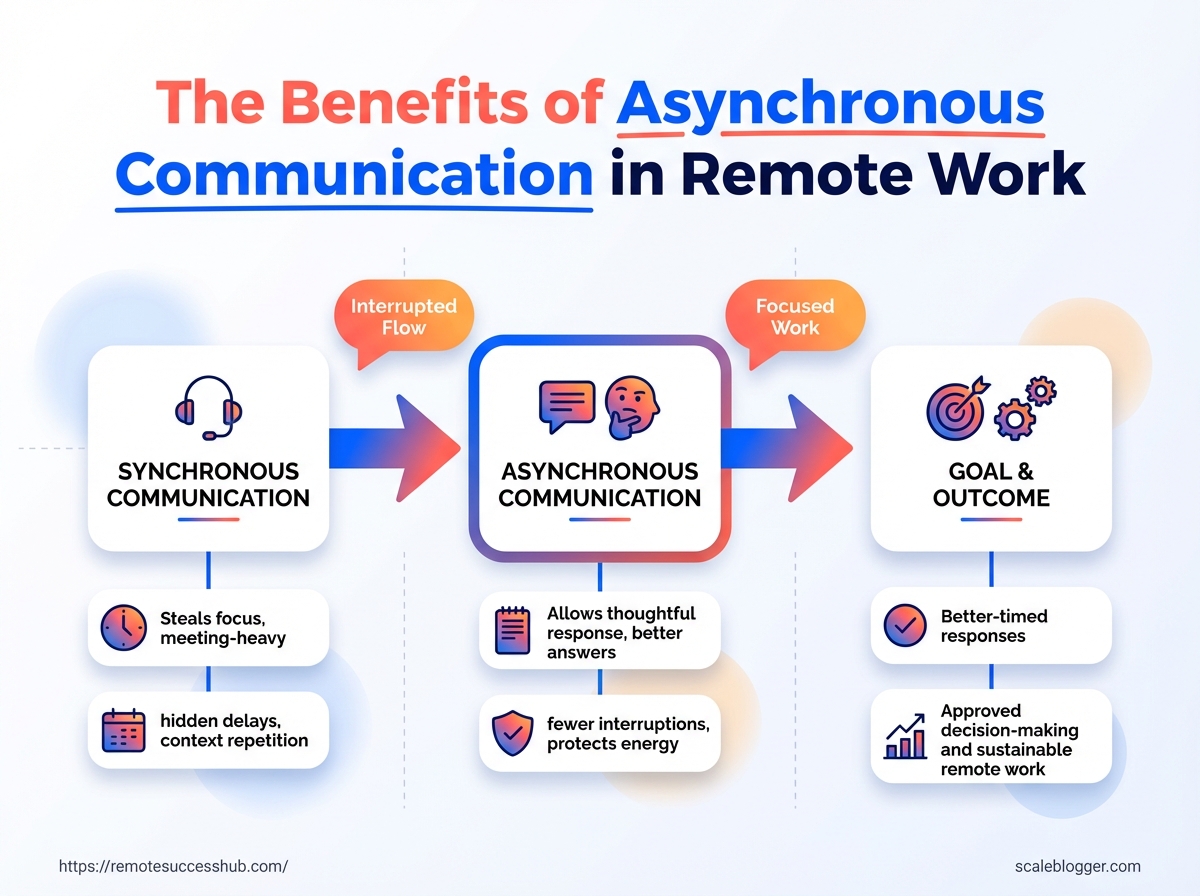
Synchronous communication has a habit of stealing focus.
A meeting pulls everyone into the same moment, even when only one person needs the answer, and that friction adds up fast across a week.
Remote teams do better when communication matches the task.
Research on hybrid work continues to show that flexibility matters to workers, but flexibility only pays off when teams stop treating every question like an emergency, as reflected in Gallup’s Global Indicator: Hybrid Work and Robert Half’s remote work statistics and trends for 2026.
A meeting-heavy workflow often creates hidden delays.
People wait for the next call, lose momentum, and end up repeating context that could have lived in a message, doc, or decision log.
That is where asynchronous communication changes the game.
It lets people respond when they have the right context, which often produces better answers and fewer interruptions, especially in teams spread across time zones.
The latest research on remote and hybrid work also keeps pointing to the same tension: flexibility improves experience, but coordination still needs structure, as discussed in InComm’s remote and hybrid work benefits overview and the University of Pennsylvania’s analysis of remote work challenges and opportunities.
- Replace instant pings with clear prompts: Ask for decisions, not live availability.
- Use shared docs for first drafts: Comments travel better than live brainstorming for many tasks.
- Reserve meetings for ambiguity: Save calls for conflict, nuance, or fast alignment.
- Write decisions down: A short log prevents repeat questions later.
Asynchronous habits also protect energy.
In 2026, research on hybrid work and daily energy dynamics noted that remote days can feel more isolating and involve more digital coordination, which makes clearer timing even more valuable.
The best remote work communication does not chase speed for its own sake.
It gives people room to think, then delivers the right message at the right moment.
Core Benefits of Asynchronous Communication
Asynchronous communication’s biggest advantage isn’t raw speed—it’s breathing room. It gives people space to think, respond, and work when their brain is actually on, not just when a notification blinks.
That matters more than it sounds.
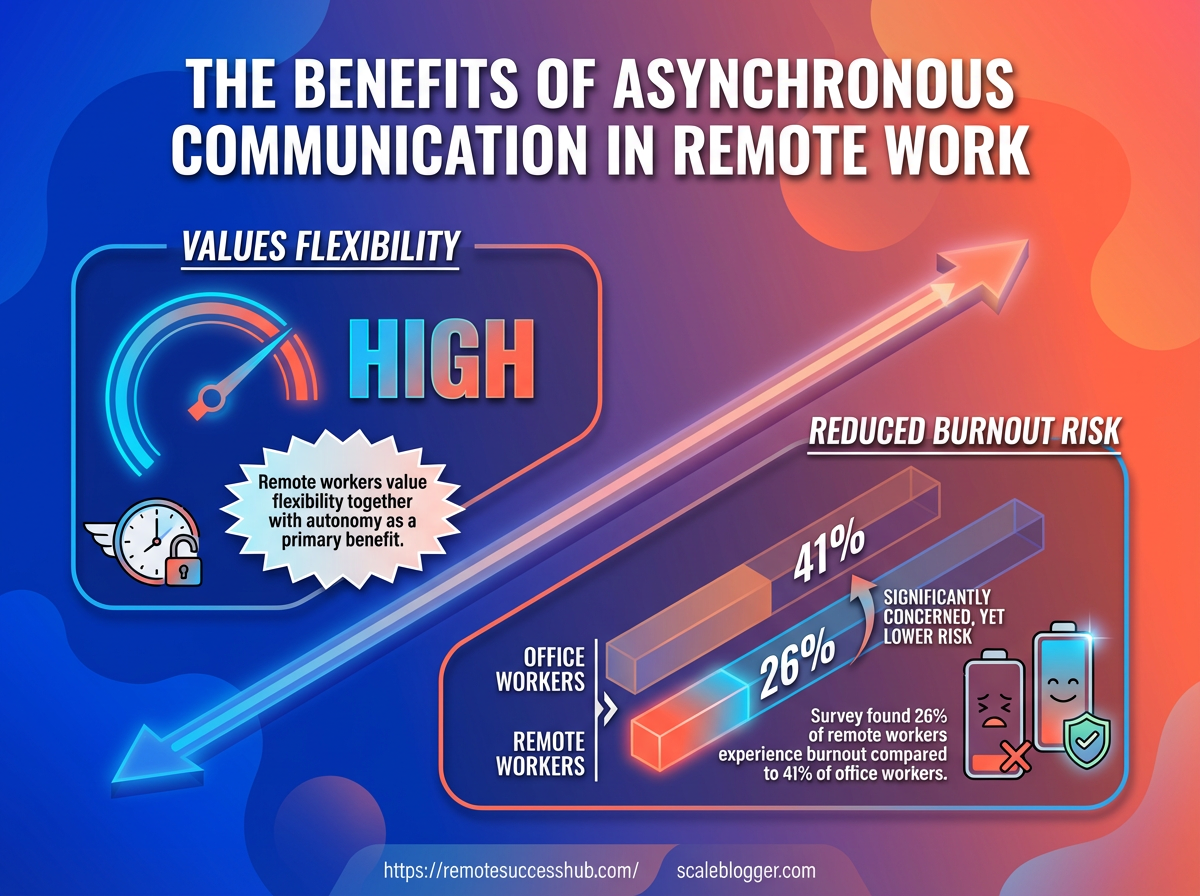
As of 2026, 71% of remote workers say flexibility helps them balance work and personal life, while 69% report increased burnout, according to Gable’s 30+ Key Remote Work Statistics For 2026.
Flexible communication is not a nice extra in that environment.
It is part of the system that keeps work sustainable.
The real advantage shows up in the way decisions improve.
When people are not forced into instant replies, they can read the context, check the details, and answer with more care.
That tends to produce better judgment, fewer half-baked decisions, and less meeting churn.
> Gallup’s Global Indicator: Hybrid Work continues to show that remote-capable employees value flexibility and choice in how they work, which fits naturally with asynchronous communication.
Where the benefits show up in daily work
| Benefit | Remote Work Problem Solved | Career Impact | Example |
|---|---|---|---|
| Flexible scheduling | Work blocks get broken by real-time pings | Better work-life balance and less stress | A designer answers feedback after deep work, not mid-task |
| Time zone constraints | Teams lose hours waiting for overlap | Faster global collaboration | A manager records updates instead of chasing live calls |
| Higher autonomy | Constant check-ins reduce ownership | Stronger decision-making habits | A specialist chooses when to review and respond |
| Responding during peak focus hours | Interruptions hit at the worst moment | Better-quality work and fewer errors | A writer replies after finishing a draft section |
| Fewer meetings | Status calls eat the calendar | More room for execution | A team uses written updates instead of a weekly sync |
| Meeting fatigue | Too many calls drain energy | Better engagement during important conversations | A product lead cuts three low-value meetings |
| More deep work time | Context switching destroys concentration | Faster output on complex tasks | An engineer protects a two-hour focus block |
| Replacing status meetings with written updates | Live updates duplicate work | Clearer progress tracking | A project lead posts a concise async update |
| Better documentation | Knowledge lives in people’s heads | Easier promotion into senior roles | A shared decision log explains why a choice was made |
| Lost context | New hires cannot reconstruct old decisions | Faster onboarding and smoother continuity | A new teammate reads prior notes instead of guessing |
| Faster onboarding and continuity | Tribal knowledge disappears when people are away | Stronger team resilience | A replacement can step in with less hand-holding |
| Shared decision notes | Decisions get forgotten after the call ends | Better follow-through and accountability | The team keeps one written record for every major choice |
Asynchronous communication cuts noise, preserves focus, and makes remote work communication easier to scale.
It also builds the kind of documentation that keeps a team useful long after the original discussion is gone.
Incomm’s overview of how remote and hybrid work benefits are evolving points in the same direction: flexibility and productivity tend to improve together when teams stop treating every question like an emergency.
That is where the benefits of flexibility become practical, not theoretical.
How Asynchronous Communication Supports Career Growth
If you want to look senior in a remote team, write things down clearly. It may sound simple, but it’s one of the fastest ways people build trust when nobody is watching you at a desk.
Strong written communication makes your thinking visible.
A clear update, a crisp decision note, or a well-structured project recap does more than share information.
It shows judgment, priorities, and the ability to separate signal from noise, which is exactly what managers notice when they cannot rely on hallway conversations.
That matters even more in a market where flexibility is still shaping hiring decisions.
Robert Half’s remote work statistics and trends for 2026 point to continued demand for flexible roles, while Gallup’s Global Indicator on Hybrid Work shows that remote-capable employees still care deeply about where and how they work.
In that environment, written clarity becomes part of your professional brand.
Ownership also becomes easier to see.
In asynchronous communication, the person who names the blocker early, documents the next step, and closes the loop on time looks far more dependable than the person who stays “busy” in chat.
> A 2026 article on hybrid work and energy dynamics in the Journal of Occupational and Organizational Psychology links remote days with more asynchronous work and digital coordination, which raises the bar for clear handoffs and follow-through. Hybrid work and daily energy dynamics
A few habits help you stand out fast:
- Write decisions, not just updates. Capture what changed, what was chosen, and why it matters.
- Use visible next steps. End notes with owner, deadline, and any risk.
- Make context reusable. A strong summary saves the next person from asking the same question twice.
- Surface blockers early. Quiet problems look small until they become team problems.
- Keep threads tidy. One topic per message keeps remote work communication easy to follow.
This is where the career upside shows up.
People who communicate well in async settings tend to be trusted with more independence, because their work is easier to track and easier to hand off.
Remote work rewards the person who makes progress legible.
When your writing does that consistently, the benefits of flexibility start turning into something even better: reputation.
Common Challenges and Practical Ways to Manage Them
A message that sits unanswered for three hours can look harmless on paper and feel awkward in real life.
In remote work communication, that gap often turns into guesswork: Is the request forgotten, blocked, or just waiting for the right time zone?
That is why delayed replies deserve their own system.
The benefits of flexibility are real, but they only feel good when people know what silence means, what counts as urgent, and when a follow-up is fair.
A 2026 report from Robert Half on remote work statistics and trends shows flexible work still matters to job seekers, while a 2026 study on hybrid work and daily energy dynamics notes that remote days can feel more asynchronous and more isolating.
That combination makes clear norms less of a nice extra and more of a survival skill.
### A simple norm-setting checklist
| Communication Norm | Recommended Standard | Why It Matters | Example |
|---|---|---|---|
| Response time | Within one business day for non-urgent messages | Prevents uncertainty | A Slack question sent Monday morning gets a reply by Tuesday morning |
| Urgency label | Use clear tags for time-sensitive requests | Helps prioritize quickly | Mark only true blockers as urgent |
| Meeting alternative | Default to written updates first | Reduces unnecessary calls | Post a weekly async recap instead of scheduling a status meeting |
| Availability window | Share core hours and offline blocks | Stops guesswork across time zones | “Online 9–12 ET, offline afternoons” |
| Decision owner | Name one person to break ties | Avoids stalled threads | The project lead approves final copy changes |
| Channel purpose | Keep each channel for one use | Reduces missed messages | Project updates stay in one thread, not scattered across DMs |
| Escalation path | Define who to ping after a deadline | Prevents silent delays | If there is no reply in 24 hours, tag the owner |
| Acknowledgment habit | Send a quick receipt before the full answer | Confirms the message was seen | “Got it, reviewing this afternoon” |
Nobody has to wonder whether a quiet inbox means deep focus, a time-zone gap, or an actual problem.
The best tools for async communication are the boring ones used well: shared docs, threaded updates, calendar blocks, and a reliable project board.
For remote teams spread across time zones, the habit that matters most is simple acknowledgment.
A fast “seen, will reply later” saves more friction than a fancy app ever will.
If a team can define urgency, availability, and fallback paths, delayed replies stop feeling personal.
That is where asynchronous communication starts to feel calm instead of chaotic.
Choosing the Right Mix of Async and Synchronous Communication
Remote communication works best when it’s intentional—not uniform. Not every message needs the same urgency, tone, or response speed.
A simple guiding rule: default to asynchronous communication when the work can survive delay, and switch to live discussion when the work depends on nuance, alignment, or fast interpretation.
This keeps remote work communication from becoming a meeting habit with too little thinking time.
When each format earns its place
| Task Type | Best Format | Reason | Example |
|---|---|---|---|
| Status updates | Async | Low urgency and easy to document | Written team update |
| Brainstorming | Sync | Benefits from real-time interaction | Live workshop |
| Decision review | Hybrid | Needs context plus alignment | Async proposal followed by brief call |
| Complex conflict resolution | Sync | Requires immediate feedback | Video discussion |
| Process changes | Async | People need time to absorb details | Written change log |
- Use async for information, archiving, and iteration. It’s best when people need time to read, compare notes, and respond with better context.
- Use sync for interpretation. It’s best when the conversation could go sideways without shared tone, immediate clarification, or direct accountability.
A practical default teams can agree on:
- If the message is factual, reversible, and easy to archive → write it down.
- If the message is emotional, high-stakes, time-sensitive, or likely to spark debate → bring it live.
When you make that swap routine, the system stays calm without slowing the team down—and people get the breathing room that async is meant to create, while keeping the moments that truly require real-time conversation.
Make Time the Tool, Not the Tangle
The idea worth keeping is simple: strong remote work communication does not mean faster replies to everything.
It means choosing the right channel, then giving people enough space to do deep work without living inside their inbox.
That is where asynchronous communication earns its place, especially when teams span time zones and the same question would otherwise trigger three meetings and a dozen pings.
The best teams treat flexibility as a design choice, not a perk.
When updates are written clearly, decisions are documented, and live calls are reserved for the moments that truly need them, people get the real benefits of flexibility without losing momentum.
That mix also helps careers, because visible, thoughtful communication often travels farther than being the loudest person in the room.
If the article pointed to one practical habit, it was this: reduce the need for instant answers by making expectations obvious. Pick one recurring conversation today and move it into a written update, a shared note, or a simple async thread with response windows.
If that feels awkward at first, our remote work resources can help you build a cleaner system that fits real remote life, not just a tidy theory of it.