
Your team’s Zoom grid is full, but not every voice gets airtime.
Meetings derail when a few people lead the conversation and the rest watch on mute.
Chat threads swell with updates and the quieter contributors vanish into the noise.
Small slights and unclear norms make belonging optional.
Async channels amplify misunderstandings when people assume everyone shares the same context.
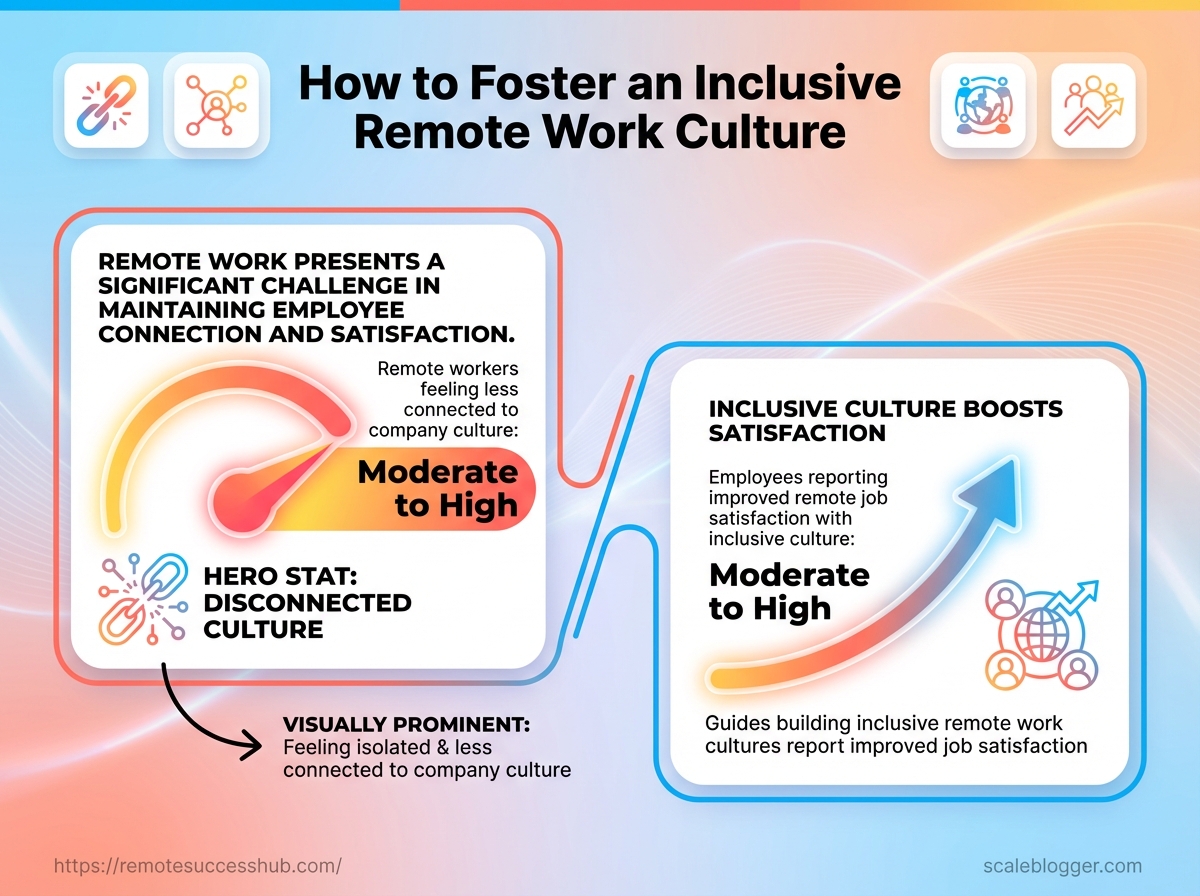
It shows up in numbers: 57% of remote workers say they feel less connected to company culture than in-office colleagues (2026).
That gap isn’t a bug — it’s a design problem.
Small changes in tools can shift who participates.
Platforms such as Zoom, Microsoft Teams and Slack offer captions, breakout rooms, and dedicated channels that lower participation barriers.
Policies and regular anti-bias training shape everyday behavior.
A 2026 LinkedIn Learning survey emphasized their importance for remote teams.
Building an inclusive remote work culture and nurturing diversity in remote teams shapes who stays and how well people collaborate.
A 2025 SHRM survey found 78% of employees said inclusive culture improved their remote job satisfaction.
Table of Contents
Reframing the Problem: Why Inclusion Matters for Remote Careers
Tactics for Individual Contributors to Build Belonging and Career Momentum
Reframing the Problem: Why Inclusion Matters for Remote Careers
Are you treating inclusion as a nice-to-have instead of a career accelerator? Most people think diversity programs only help the organization.
They miss how inclusion directly boosts an individual’s visibility, influence, and promotion odds in remote settings.
Building an inclusive remote presence means more than joining ERG channels.
It’s about designing meetings, feedback loops, and project roles so different voices are seen and credited.
That shift changes outcomes people notice: productivity, retention, and mobility.
78% of employees said an inclusive culture improves their job satisfaction in remote work settings (Society for Human Resource Management, 2025).
57% of remote workers reported feeling less connected to company culture than in-office peers (Buffer, 2026).
Why inclusion accelerates career progress
An inclusive team produces clearer signals about contribution.
When meetings use breakout rooms, real-time captioning, or Together Mode, quieter contributors get airtime and attribution.
Tools like Zoom and Microsoft Teams are built to support that.
Organizations with inclusive practices also retain talent longer.
Longer tenure creates more senior opportunities and internal mobility.
The connection between inclusion and retention is visible in employee satisfaction data from 2025 and 2026.
Consider a scenario where a project lead intentionally rotates facilitation across timezones.
Contributors who might otherwise stay invisible become project owners.
That ownership turns into portfolio work that hiring managers notice.
Common misconceptions about diversity in remote teams
Believing remote work is automatically equitable is risky. Equal access to a laptop does not equal equal influence. Another myth is that inclusion slows decisions.
In reality, inclusive teams avoid rework and reduce turnover, which speeds long-term delivery.
Finally, some leaders think tools alone fix bias.
Tools help, but combined policies and regular anti-bias training—reported as critical in a 2026 LinkedIn Learning survey—are what sustain change.
Practical steps to show inclusion-driven leadership
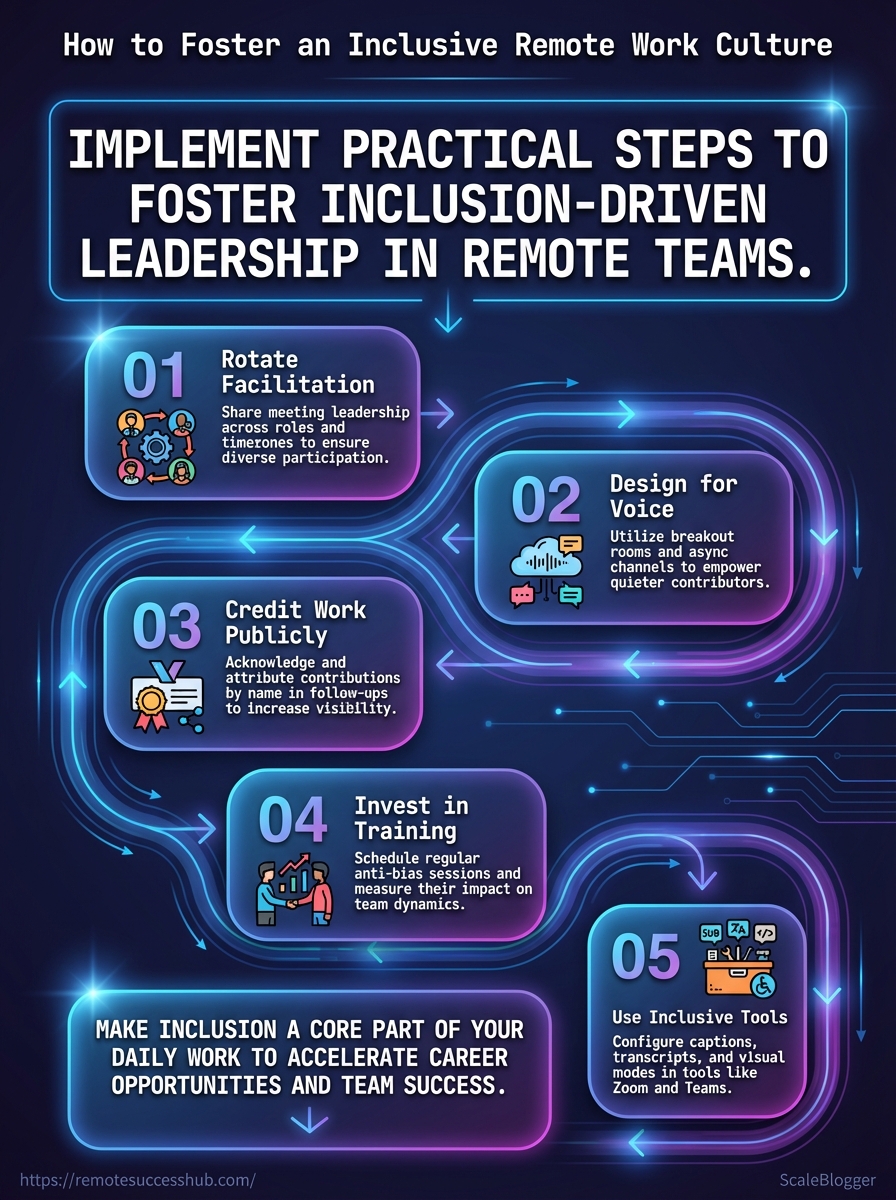
Rotate facilitation: Share meeting leadership across roles and timezones.
Design for voice: Use
breakout roomsand async channels so quieter people contribute.Credit work publicly: Call out contributors by name in follow-ups.
Invest in training: Schedule regular anti-bias sessions and measure impact.
Use inclusive tools: Configure captions, transcripts, and visual modes in Zoom and Teams.
Platforms like https://remotesuccesshub.com/ collect playbooks and tools that make these steps reproducible across teams. Inclusion isn’t philanthropy; it’s a career strategy.
Make it part of your daily work and watch opportunities follow.
Core Principles of an Inclusive Remote Work Culture
An inclusive remote work culture is essential and needs concrete principles: psychological safety and visible belonging, equitable access to work and growth, and inclusive communication norms.
These principles are operational rules shaping daily actions — from meetings to feedback loops.
Studies consistently show that inclusive cultures boost job satisfaction significantly, creating environments where diverse voices are appreciated.
As remote teams design their processes, they will often find that operationalizing these principles helps reduce hidden barriers and fosters a more equitable workplace, vastly improving overall engagement.
Foundational Policies and Norms to Implement
Are remote team practices accidentally rewarding people who happen to be online at the right time? That invisible bias is real, and it shapes who gets noticed, mentored, and promoted.
Intentional policies close that gap. When teams adopt asynchronous-first norms, clear promotion rubrics, and equitable scheduling rules, remote employees gain predictable pathways to visibility and advancement.
Recent data underlines the risk: a 2026 Buffer report found 57% of remote workers feel less connected to company culture, while a 2025 SHRM survey reported 78% believe inclusive cultures boost job satisfaction.
Those numbers make policy design a business priority.
Asynchronous-first policies and timezone equity
Moving to an async-first default reduces meeting load and levels the playing field for teammates in distant zones.
It’s not about banning meetings; it’s about reserving real-time time for decisions that actually require synchronous back-and-forth.
Practical steps matter.
Use written decision records, async standups in shared docs, and time-zone-aware deadlines that avoid penalizing non-overlap contributors.
Tools like Zoom and Microsoft Teams help with accessibility—real-time captioning and recorded sessions—but policy must require documentation of decisions so contributors who can’t attend still get credit.
Default to written decisions: Post outcomes and rationale in a searchable place within 24 hours.
Set expected response windows: Define
urgentvsroutinereply times so people aren’t judged for delayed answers.Rotate meeting times: When sync is necessary, rotate schedules to distribute inconvenience fairly.
Timezone pairing: Assign project buddies across zones to maintain onboarding and mentoring equity.
Timezone equity: A policy that balances meeting timing, deadlines, and visibility so employees are not disadvantaged by their local hour. Async-first: Prioritizing recorded, written, or delayed collaboration over real-time interaction unless an outcome requires immediate sync.
Transparent promotion and performance guidelines
Opaque promotion paths amplify remote disadvantage.
Public, role-specific rubrics make expectations explicit and defend against subjective bias.
Create documented ladders, example projects for each level, and a standardized promotion packet process that accepts asynchronous evidence (recorded demos, project logs, peer-written impact notes).
Make calibration meetings timezone-rotated and include written notes from every panel.
Publish role ladders: Show competencies, examples, and time-in-role norms.
Standardize evidence: Require objective artifacts—metrics, customer feedback, code reviews—for promotion packets.
Bias checkpoints: Pair promotion panels with anti-bias questions and rotating schedules.
Open timelines: Share promotion cycles and next-review windows publicly.
Comparison of policy types and impact on inclusion
Policy | How it supports inclusion | Potential drawbacks | Impact on visibility & career progression | Quick implementation tip |
|---|---|---|---|---|
Async-first | Lowers meeting burden; documented decisions increase credit for contributors | Can slow decision speed for urgent issues | Improves visibility for asynchronous contributors by creating written trace | Start with one team and require decision notes for every meeting |
Core hours | Creates predictable overlap for live collaboration | Favors those in similar timezones; may exclude distant hires | Can help visibility if overlap equals sponsor access; otherwise harms distant staff | Limit core hours to 2–3 hours and use them sparingly |
Flexible schedules | Supports diverse personal responsibilities and energy cycles | Visibility risk if availability varies widely | Neutral-to-positive when paired with async documentation | Require shared calendars and status updates |
Meeting-free days | Preserves heads-down time for deep work | Hard when teams rely on daily syncs | Boosts deliverable-driven visibility rather than presence-driven | Pilot one day per week and measure output |
Rotation of meeting times | Shares inconvenience across zones | Scheduling complexity increases | Equalizes access to live interactions and sponsor moments | Publish rotation schedule quarterly |
Time zone pairing | Ensures cross-zone mentorship and onboarding | Requires ongoing matching effort | Directly improves networking and career sponsorship | Formalize pairs for first 90 days of projects |
Documented promotion rubrics | Removes ambiguity from advancement | Needs maintenance to stay current | Strongly positive — reduces subjective gatekeeping | Publish rubrics and examples in team wiki |
Asynchronous hiring/interviews | Reduces scheduling bias and widens candidate pool | May miss spontaneous chemistry cues | Broadens pipeline for underrepresented candidates | Offer recorded task-based assessments plus live follow-up |
Accessibility-first meetings (captions, transcripts) | Makes participation possible for more people | Slightly higher meeting prep/time | Increases equitable participation and recorded visibility | Turn on captions and record every meeting by default |
Regional pay & role transparency | Helps manage expectations across markets | Can create internal tension if not communicated | Supports retention and fair progression when used with clear criteria | Publish compensation bands alongside role ladders |
Putting these policies next to each other shows trade-offs: synchronous-heavy approaches often boost short-term collaboration but hurt long-term inclusion unless paired with strong documentation and rotation.
A few concrete norms—async defaults, public promotion rubrics, rotating meeting schedules—produce outsized returns in fairness and career clarity.
Templates and checklists from platforms like https://remotesuccesshub.com/ can speed adoption and reduce implementation friction.
Manager Playbook: Daily and Quarterly Actions
Ever notice that the teams who look inclusive on paper still leave people out in day-to-day rhythms? Daily habits and quarterly rituals are where inclusion either lives or fades.
Treating inclusion like a calendar item won’t cut it; it needs repeatable manager actions that produce visible career outcomes.
Start the day-to-day with simple, observable behaviors: structure, predictable access, and explicit visibility practices.
Managers should run the same checklist each week so opportunities and feedback reach everyone, not just the loudest voices.
Every quarter, layer on systemic checks: hiring slate reviews, promotion calibration, and workload audits.
Those quarterly checkpoints turn daily inclusive gestures into measurable career acceleration.
Inclusive hiring and onboarding practices
Make hiring predictable and fair by removing ambiguity from every touchpoint.
Standardize job descriptions to focus on outcomes and must-have skills, not culture fit language that favors one profile.
Use a structured interview scorecard and require at least one interviewer trained on bias mitigation on every panel.
Diverse slates: require candidates from multiple backgrounds before opening interviews.
Work-sample assessments: use take-home or pair-programming exercises that reflect remote work contexts.
Transparent timelines: publish interview steps and decision dates to reduce uncertainty for candidates.
Onboarding buddy: Pair new hires with a peer for the first 30 days to surface informal networks and reduce isolation. 30/60/90 checkpoints: Schedule explicit role clarity and expectation conversations at 30, 60, and 90 days, and document outcomes.
Designing inclusive meetings and async workflows
Run meetings to surface quieter contributors and compress decision-making friction.
Start with meeting roles—facilitator, timekeeper, note-owner—and rotate them each session.
Rotate meeting times: alternate times quarterly to accommodate global schedules.
Use hybrid patterns: run an
async-plus-liveworkflow—pre-read doc, 20-minute live sync, and follow-up thread for decisions.Leverage tech for equity: enable captions and breakout rooms in Zoom, use Together Mode in Microsoft Teams when it helps, and create dedicated Slack channels for follow-up.
Record decisions in a central, searchable doc so people joining asynchronously can see the rationale and action owners.
Coaching for visibility and equitable career paths
Visibility is a skill that needs coaching and sponsorship. Make week-by-week actions part of 1:1s: ask what work the person wants noticed, who should see it, and which stakeholders to brief.
Weekly career touch: block 10 minutes in 1:1s for “visibility moves.”
Sponsor nominations: each quarter, managers must add at least one direct report to a high-visibility project or stakeholder meeting.
Promotion calibration: run a quarterly calibration meeting to compare expectations, assignments, and outcomes across the team.
This walkthrough demonstrates a manager running a 30-minute async-plus-live meeting that centers equal participation and follow-through.
Watch for facilitator scripts and the post-meeting documentation pattern shown.
These daily habits and quarterly rituals make inclusion operational rather than aspirational.
For practical templates and checklists you can drop into team rhythms, platforms like https://remotesuccesshub.com/ have ready-made tools and examples.
Tactics for Individual Contributors to Build Belonging and Career Momentum
Want promotions without turning every extra hour into a habit? Remote career momentum comes from making impact visible, deliberately growing your network, and keeping crisp records of contributions.
Those moves protect time while increasing leverage.
Remote workers who feel connected are more likely to stay and perform.
A 2026 Buffer report found 57% of remote workers feel less connected to company culture than in-office peers, which makes deliberate community-building a career skill, not a nicety.
Use simple, repeatable tactics that scale with your workload and personality.
Visibility without overwork Start with a lightweight, repeatable system you actually maintain.
Create an Impact Log — a one-page living document that lists outcomes, metrics, and stakeholder names for projects you touch. Updating it weekly takes 10–15 minutes and gives you material for status updates, performance reviews, and promotion conversations.
Make asynchronous visibility work for you.
Share short, outcome-focused updates in team channels or project threads instead of long weekly emails.
Use tools like Zoom or Microsoft Teams strategically: volunteer to demo results in a 10-minute slot or request a short screen-share during a recurring meeting to show measurable progress.
Weekly Impact Snapshot: Two-sentence result + one metric (≤15 words).
Stakeholder Tagging: Name the two people directly affected by the result.
Public Archive: Post snapshots in a team channel or project doc for searchability.
One-minute Demo: Record a 60–90 second screen walk-through when possible.
Building community and sponsorship remotely Sponsors accelerate careers by advocating for you in rooms you can’t always attend.
Building those relationships requires small, consistent investments that don’t steal evenings.
Start by joining or creating focused Slack channels or interest groups.
Use Zoom breakout rooms or Microsoft Teams’ Together Mode for informal, recurring coffee chats.
Invite a potential sponsor to a short 1:1 coffee to discuss challenges they care about, not just your asks.
Micro-sponsorship ask: One-sentence request for a specific introduction or feedback.
Regular mini-ritual: 20-minute biweekly check-ins with cross-team peers.
Value-first approach: Offer a concrete resource or help before asking for advocacy.
Channel contribution: Post useful insights twice a month in a company or community channel.
Negotiation and documentation habits that advance careers Negotiate from documented impact.
Before a compensation or role ask, pull three entries from your Impact Log that map to business outcomes.
Frame requests as specific outcomes: higher revenue, faster delivery, or reduced churn.
Prepare: list 3 outcomes, current responsibilities, and market reference points.
Anchor: state a clear, data-backed ask (number or title) with a 2-week decision window.
Backfill: attach one-page
Impact Logexcerpts and stakeholder notes.Follow-up: send a concise recap and next steps within 48 hours.
78% of employees say an inclusive culture improves job satisfaction in remote settings (Society for Human Resource Management, 2025).
Small, consistent documentation and networking moves create visible momentum without extra hours.
Keep your systems tiny, public where useful, and repeatable — career progress compounds when signals are clear and low-effort.
📥 Download: Download Template (PDF)
Measuring Inclusion: Metrics, Feedback Loops, and OKRs
How do you know inclusion is actually improving, rather than just feeling like good intentions? Metrics turn subjective commitments into decisions you can act on.
Measuring both feelings (qualitative) and behaviors (quantitative) stops inclusion from being a checkbox and makes it a repeatable part of team rhythms. Start with a compact dashboard that blends pulse surveys, platform analytics, and HRIS outputs.
Track signals that predict career outcomes — not just participation.
That way, experiments have clear success criteria and teams can iterate quickly.
Design OKRs that pair aspirational targets with concrete leading indicators.
For example, an Objective might be “Increase equitable career mobility for remote hires,” with Key Results tied to promotion parity, mentorship match rates, and perceived belonging scores.
78% of employees say inclusive culture improves job satisfaction in remote settings (Society for Human Resource Management, 2025).
57% of remote workers report feeling less connected to company culture than in-office peers (Buffer report, 2026).
What to measure: qualitative and quantitative metrics
Start with two lenses: how people feel and what they do.
Feelings surface bias that numbers miss.
Behaviors reveal structural barriers that surveys can only hint at. Sense of belonging: Average pulse survey score on inclusion items (1–5).* Promotion rate by demographic: Percentage of promotions per demographic cohort over 12 months.* Participation in async channels: Active contributors as percentage of team on Slack/Microsoft Teams.* Meeting contribution parity: Share of speaking time or chat contributions by underrepresented groups.* Retention rate for remote hires: 12-month retention for remote vs. on-site hires.*
Sample metrics dashboard and OKRs
Below is a compact dashboard template teams can copy and adapt.
Baselines and targets are realistic examples; replace with your HRIS and survey outputs.
Metric | Definition | Baseline example | Target | Collection frequency | Primary data source |
|---|---|---|---|---|---|
Sense of belonging (survey score) | Avg. score on inclusion items (1–5) | 3.6 | 4.2 | Quarterly | Engagement surveys |
Promotion rate by demographic | Promotions ÷ eligible employees per cohort | 6% overall; 4% for underrepresented group X | 8% overall; 8% for all cohorts | Annual | Anonymized promotion data |
Participation in async channels | % active contributors in last 90 days | 42% | 60% | Monthly | Slack/Microsoft Teams analytics |
Meeting contribution parity | % of total contributions by demographic | 28% from underrepresented groups | 45% parity | Per meeting; aggregated monthly | Meeting transcripts/Teams analytics |
Retention rate for remote hires | % retained after 12 months | 72% | 85% | Annual | HRIS exports |
Mentorship match rate | % of requests matched to mentors within 30 days | 55% | 90% | Monthly | Mentorship program data |
Onboarding satisfaction | New hire survey avg. score (1–5) | 3.8 | 4.5 | 30 days post-hire | New hire surveys |
Accessibility requests fulfilled | % of accommodations completed within SLA | 68% within 2 weeks | 100% within SLA | Continuous | HRIS + Accessibility ticketing |
Time-to-promotion (remote hires) | Median months from hire to promotion | 30 months | 24 months | Annual | HRIS exports |
Career mobility index | Composite score of stretch assignments, mentoring, promotions | 0.45/1.0 | 0.70/1.0 | Quarterly | HRIS + Program trackers |
This dashboard mixes leading and lagging indicators so managers can course-correct before outcomes diverge.
Closing the loop: running experiments and iterating
Build a simple hypothesis-driven cycle that fits a remote cadence.
Start small, measure, and scale what works.
Define hypothesis and metrics: pick one Objective and 2–3 Key Results aligned to the dashboard.
Run a time-boxed experiment: deploy a change (e.g., structured speaking rounds, async-first decision logs) for 6–8 weeks and capture
participation_rate = contributions / attendees.Analyze both numbers and stories: combine survey comments, platform analytics, and manager reports to interpret impact.
Iterate or scale: if KR improvements meet thresholds, expand the experiment; if not, adjust variables and repeat.
the loop turns inclusion from an annual audit into a continuous product.
Measure regularly, listen openly, and treat each KPI as a hypothesis to test.
Common Pitfalls and How to Recover
Ever read a meeting transcript and felt a few names never really show up? That quiet pattern often signals inclusion problems that silently erode careers.
Most teams trip on the same three traps: token gestures that feel performative, timezone imbalances that leave people out of decision loops, and an always-on rhythm that rewards visibility over impact.
Recovering from those mistakes requires deliberate fixes that restore trust, redistribute influence, and make contribution visible without burning people out.
There are practical fixes that work within common tooling and budgets.
Start small: adjust meeting formats, change recognition norms, and run short pilots that prove value.
Use real data to make the case to leaders so the fixes survive the first quarter.
Unintended exclusion: tokenism, timezone bias, and always-on culture
Token gestures — a single hire or a one-off celebration — can backfire when they don’t change who gets real power or access.
Tokenism feels superficial and quickly erodes credibility.
Timezone bias shows up when important chats and ad-hoc calls happen during a single region’s workday.
That creates invisible promotion barriers for people outside that window.
Always-on cultures reward immediate responders.
That favors those who live near core hours and punishes caregivers and neurodiverse people.
Rotate meeting windows: Alternate core meeting times so no region is always disadvantaged.
Commit to
asyncprework: Share agendas and decisions in advance so contributors can prepare outside real-time calls.Design recognition rituals: Public praise in channels and written highlights prevent reward-by-visibility.
Set response SLAs: Declare expected reply windows to avoid rewarding always-on behavior.
Addressing micro-inequities in async communication
Micro-inequities are tiny slights in messages that add up. They include interruptive replies, dismissive reactions, and invisible edits to documents without attribution.
Run a short audit: export a month of #team and #project threads and flag patterns — who interrupts, who’s left unanswered, which threads finish decisions without inclusive sign-off.
That reveals repeat dynamics.
Train contributors on
asyncnorms: one idea per thread, explicit ask, and named next steps.Assign a rotating async moderator to summarize decisions and call out missing voices.
Use tooling to reduce bias: Slack threads for focused topics, and structured forms for proposals to standardize input.
Measure change monthly and share results in a visible channel.
When initiatives stall: stakeholder alignment and funding
Initiatives stall when budget cycles misalign or sponsors lose sight of impact.
That often looks like a good pilot that dies when a leader changes roles. Sponsor: A senior person who protects budget and removes roadblocks. Champion: A frontline leader who runs the work and reports progress. Sponsor alignment: Regular check-ins that map initiative outcomes to business metrics and people metrics.
If funding is the barrier, propose a 6–8 week pilot with clear success metrics.
Use language executives respond to: improved retention, reduced time-to-decision, or faster hiring velocity.
Back the ask with data — for example, many employees report inclusion affects job satisfaction (78% in a 2025 SHRM survey) and over half of remote workers say they feel less connected to company culture (57% in a 2026 Buffer report).
Use those numbers to frame risk and ROI.
Recoveries are practical and reversible.
Start with small experiments, show results fast, and make the case with data.
Tools, Templates, and Resources
Do your tools help people belong, or just keep work moving? Picking platforms with inclusive defaults changes who gets heard and whose work gets noticed.
Remote teams need systems that make participation simple across time zones, languages, and accessibility needs.
Two facts matter: 78% of employees say an inclusive culture improves job satisfaction (Society for Human Resource Management, 2025).
And 57% of remote workers report feeling less connected to company culture than in-office colleagues (Buffer, 2026).
Tools that surface diverse voices and make asynchronous contribution easy close that gap.
57% — A 2026 Buffer report found remote workers feel less connected to company culture than in-office peers, which makes tooling choices strategic rather than cosmetic.
Recommended tools and how to choose them
Tool | Category | Key inclusion features | Best for | Integration notes |
|---|---|---|---|---|
Notion | Async documentation | Rich templates, granular permissions, inline comments, version history | Knowledge base and async onboarding | Integrates with Slack, calendar embeds; mobile-friendly; keyboard navigation aids |
Confluence | Async documentation | Page templates, page restrictions, review workflows | Enterprise documentation with structured access | Works with Jira, SSO, enterprise compliance controls |
Slack | Collaboration/chat | Channels for affinity groups, threads, app ecosystem, message pinning | Real-time chat and ERG coordination | Connects to Zoom, Notion, HRIS; supports accessibility apps |
Microsoft Teams | Collaboration/chat | Together Mode, live captions, Immersive Reader | Video + chat for orgs invested in Microsoft stack | Deep Office 365 integration; calendar and SSO support |
Zoom | Meeting/video | Breakout rooms, live transcription, dual-screen gallery | Large meetings and inclusive facilitation | Integrates with Slack/Calendar; captions and recording transcripts |
Miro | Visual collaboration | Templates for ideation, asynchronous comments, voting | Collaborative workshops and whiteboarding | Exports to Confluence/Notion; timezone-friendly facilitation tools |
Loom | Async video | Quick recorded walkthroughs, viewer analytics, captions | Onboarding and async status updates | Links embed in docs and chat; captions improve accessibility |
Greenhouse | Interviewing/hiring platforms | Structured interview kits, scorecards, diverse slate features | Scaling fair hiring processes | Connects to HRIS/LinkedIn; supports anonymized scorecards |
Culture Amp | Engagement survey tools | Demographic filters, action plans, manager reports | Continuous inclusion measurement and development | HRIS integrations; secure handling of sensitive demographics |
Metabase | Analytics/dashboard tools | Self-serve dashboards, filters by groups, Slack alerts | Lightweight inclusion and hiring dashboards | Connects to most databases; embed charts in docs and Slack |
This mix prioritizes accessibility (captions, reader modes), async-first features (recorded updates, persistent docs), and hiring fairness (structured interviews, scorecards).
Choose based on scale, existing stacks, and data sensitivity.
Ready-to-use templates
Start with a short intro before templates.
The onboarding script below is intentionally concise so new hires get clarity without overload.
The inclusive meeting agenda forces turn-taking and async options into the rhythm of your team.
Onboarding script (first week)
Day 0: Welcome email with role owner, 1-page org map, first-week checklist, and links to onboarding Notion pages.
Day 1: 30-minute async welcome video (
Loom) from manager + scheduled 1:1 in new hire’s timezone.Day 2–5: Role-specific async tasks, one live Q&A (recorded), list of ERG channels and how to join.
End of week: Feedback pulse via Culture Amp or short form and a 30-minute reflection 1:1.
Before each list item use short, clear language and assign owners.
Inclusive meeting agenda (use in invite body)
Purpose: One-sentence meeting goal.
Pre-work (10 min max): Document link and question prompts.
Roles: Facilitator, timekeeper, note-taker, accessibility monitor.
Round-robin updates (2 min each): Use camera optional + chat options.
Async follow-ups: Clear action owner, deadline, and doc link.
How to choose tools
Start with clarity about the problem: hiring bias, participation gaps, or engagement blind spots.
Assess: Prioritize features that directly reduce exclusion (captions, structured hiring).
Pilot: Test with a representative group across time zones.
Measure: Connect tools to your inclusion analytics so adoption and outcome are visible.
Practical templates and tool comparisons reduce guesswork.
Downloadable versions of these templates are available on platforms like https://remotesuccesshub.com/ if you want ready files to adapt.
These choices make building a truly inclusive remote work culture repeatable and measurable.
Conclusion
Make inclusion a daily habit, not an annual checkbox
Inclusion only matters when it changes how people show up every day.
The single most valuable insight is that small, repeatable practices — who gets time to speak, how feedback is collected, and whether participation is measured — create an inclusive remote culture that scales beyond policies.
When managers follow the playbook’s daily routines and quarterly OKRs, quieter voices stop being exceptions and become part of the normal rhythm.
Concrete examples from the article show this: rotating meeting facilitators, using async pre-reads, and tracking pulse responses turn abstract commitments into measurable behavior.
Those tactics nudge diversity in remote teams from aspiration to habit by lowering friction for underrepresented contributors and making accountability visible.
Building remote team culture this way also gives individuals clear actions to grow their careers.
Start with one simple experiment today. Run a 15-minute inclusion audit in your next team meeting: ask two quick pulse questions, rotate the facilitator, and pick one measurable change to try next quarter. Use a single spreadsheet or templates from platforms like Remote Success Hub to capture results.
Will you schedule that 15-minute check before the week ends?